Do your values match your behavior?

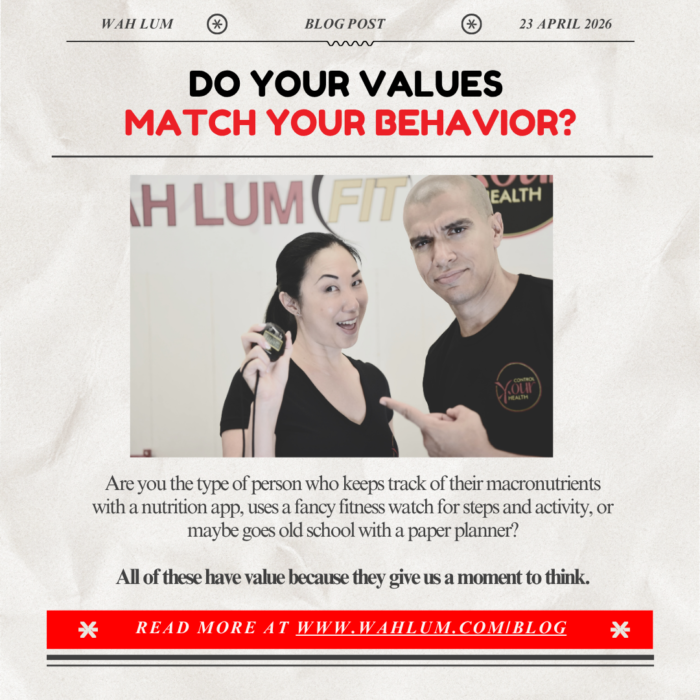
Are you the type of person who keeps track of their macronutrients with a nutrition app, uses a fancy fitness watch for steps and activity, or maybe goes old school with a paper planner?

All of these have value because they give us a moment to think.

But a challenge is getting caught up in the exact metrics of our training. We want the perfect routine, with the exact number of reps to reach our goals. 

Taking a moment to think and plan is incredibly valuable, but have you noticed that if something is truly valuable to you, it shows up in multiple places?

Look around your life right now.

  • If you care about learning, books begin to pile up around the house.
  • If you care about people and community, gatherings start to happen naturally.
  • If you care about health, you suddenly find yourself walking more or making better choices without having to force it.

The same thing happens in your martial arts training.

If you value your Kung Fu or Tai Chi skill, you will find a way to practice… even if you can’t make it to the Temple to train. Someone who values movement will always find time to stretch, practice their forms, or simply play.

Your values leak into your behavior. 

This explains why overly complicated training systems or extreme diets almost always fail. They try to force a set of behaviors without ever addressing your underlying values. If you don’t actually value the outcome, no chart, tracking app, or new program is going to save you.

But once a value is clear in your mind, the system becomes incredibly simple. You don’t need external motivation to do the things that truly matter to you. They begin to show up on their own, seamlessly blending into your day.

I like to get steps in when I do yard work or am cleaning up around the Temple. I don’t need a complex system to make it happen; I value the movement, so the behavior follows.

I also value the amount of money I spent on the pants I currently own, so I usually turn down the extra serving of cookies or cake (not always! but usually).

Take a moment to look at your daily habits today. What values are leaking into your behavior right now?

See you in training,

Sifu Oscar


P.S. Make movement a value. People often fail to start training because they think they need a complicated system to begin. You don’t. You just need to show up. If you are ready to build a new habit, here are 2 ways I can help:

  1. See it for yourself: The best way to understand Wah Lum is to see it in person. Comment with OBSERVATION and we will set up a time for you to come visit a class.
  2. Start from home: Comment with FOUNDATIONS and I’ll send you the details for our 21-day remote prep program.

Do you need to add, or do you need to shed?

Hello, Wah Lum Family!

The author James Clear shared a thought that struck a chord with how we approach our training:

“There are two ways to grow: by adding or by shedding. Do you need to add something or do you need to shed something?”

Our default setting is usually to add. We want to learn a new form, pick up a new weapon, lift heavier weights, or train more days a week.

But often, the biggest leap in our progress comes when we choose to shed. And usually, what we need to shed is the expectation that we must excel at everything all the time.

You cannot be at your best every day

We put an immense amount of pressure on ourselves to perform perfectly every time we step onto the training floor. But as my strength coach Brett Jones has reminded me many times:

“Only the mediocre are at their best all of the time.”

If you are always at your “best,” it means you are staying entirely within your comfort zone. You aren’t pushing the boundaries of your mobility, your strength, or your mind. Real growth is messy. It means having days where your stances feel weak, your mind is foggy, and you feel like you are taking two steps back.

Implementation over Ideas

When we accept that we won’t be perfect every day, we realize a fundamental truth about Kung Fu and life: What prevails is rarely the best idea, but the best implementation.

You don’t need a secret, magical training protocol. You just need to show up and do the work, even when you aren’t at your best.

It is only now, after 25+ years in Wah Lum, that I can truly appreciate this. As I reflect on my own limitations and what I might humbly call my own “mediocrity” compared to the ideal, I am more in awe of Grandmaster Chan than ever. His great skill didn’t come from being perfect every single day; it came from relentless, decades-long implementation.

The power of the “Amateur”

So, if we aren’t going to be perfect, and if we are constantly humbled by the art, why do we keep doing it?

There is a great quote from the show Mozart in the Jungle that captures the mindset we need to cultivate:

“You say ‘amateur’ as if it was a dirty word. ‘Amateur’ comes from the Latin word ‘amare’, which means to love. To do things for the love of it.”

Shed the need to be perfect. Shed the frustration of not being at your best today.

Embrace being an amateur. Step onto the floor, put in the reps, and train simply for the love of the art.

See you in training,

Sifu Oscar


P.S. Whenever you’re ready, here are ways we can help you get started.

1. Schedule a time to observe a class.
Interested in Kung Fu or Tai Chi?  First step is to watch a class and see if we would be a good fit! Email: kungfu@wahlum.com for an appointment.

2. Become part of my exclusive Coaching Group with CYH Remote Coaching.  Get personalized coaching delivered right to your phone and catered to your specific goals.
Email: kungfu@wahlum.com for info.

Stop Competing With Your Ideal

I’ve been thinking a lot about the words we use, and how they shape our Kung Fu and Tai Chi training. There are two words that are often mixed up, and confusing them can mess with your progress:

Ideal and Optimal.

The Trap of the “Ideal”

The Ideal has to do with comparison.

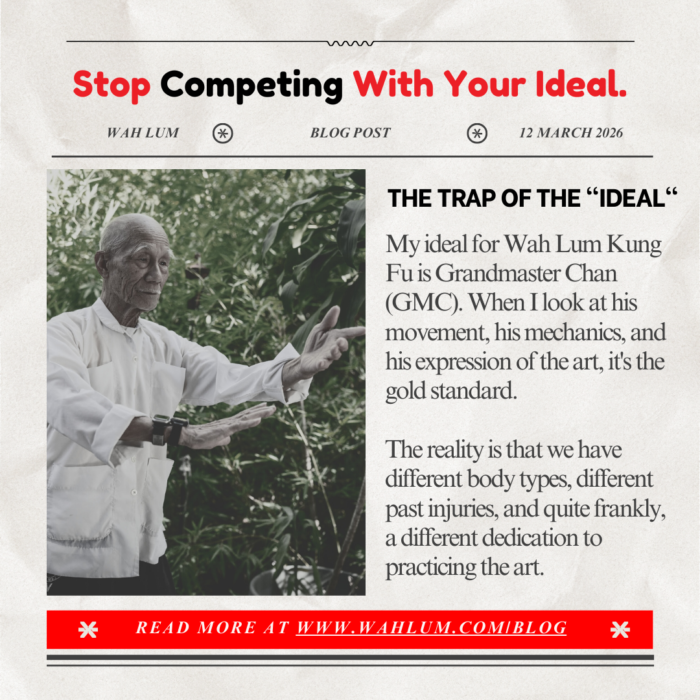
My ideal for Wah Lum Kung Fu is Grandmaster Chan (GMC). When I look at his movement, his mechanics, and his expression of the art, it’s the gold standard.

The reality is that we have different body types, different past injuries, and quite frankly, a different dedication to practicing the art.

For example, Sifu Tu is another ideal for me. When standing, we are different heights, but when sitting, we are the same height. Sifu Tu started at around 10 with full splits and a lot of focused training; I started in my 20s with shoulder injuries, overall stiffness, and exercise ADD (always having different training goals).

I can and do use GMC, Sifu Tu, or Sifu Mimi as ideals to motivate me and give me a North Star to aim for. 

But I will not compete with my ideal. 

Treating the ideal as the standard, I have to perfectly match every day, which places me in an external competition that I cannot win. I would constantly feel like I am falling short, which ultimately leads to deep disappointment and burnout.

The Power of the “Optimal”

Your optimal self is not a fantasy version of you. It isn’t even the best you hope to be five years from now.

Your Optimal is the best you can do today. Right now.

It’s the best you can do with the body you bring to the training floor today. With your current physical reality. With the stress you are carrying from work. With the sleep you got last night.

  • The Ideal is external comparison.
  • The Optimal is internal competition.

When you stop comparing yourself to the Ideal and start competing with yourself to find today’s Optimal, that is when true, sustainable improvement happens.

Preparing for the Unknown

This shift in mindset changes how we train.

We don’t train just to plan for one specific, “ideal” scenario, because in training, as in life, the ideal scenario rarely happens.

Instead, we prepare by building an optimal mindset. A mindset that doesn’t shatter when things aren’t perfect. A mindset that can handle uncertainty and still execute the best possible response with whatever tools are available in that exact moment.

Let the Ideal inspire you. Let the Optimal drive you.

See you in training,

Sifu Oscar


P.S. Stop waiting for the “ideal” time. People delay starting martial arts because they are waiting for the ideal time—when work slows down, when they lose 10 pounds, when life is less stressful. The ideal time is a myth. The optimal time is today, with your life exactly as it is. Here are 2 ways I can help:

  1. See it for yourself: The best way to understand Wah Lum is to see it in person. Comment with OBSERVATION, and we will set up a time for you to come visit a class.
  2. Start from home: Comment with IDEAL and I’ll send you the details for our 21-day Foundations program.

What Mozart Told the 21 Year Old

Hello Wah Lum Family,

There are two ways to climb a mountain.

You can start at the bottom and make every single mistake from scratch on your way to the top. Or, you can take a Sherpa with you and master the best of what others have already figured out.

We often hear that “mistakes are the best teachers.”

I don’t know about that.

Your mistakes aren’t the best teacher; they are just the most expensive. The successful learn by example; they learn from the experience of their Sifu and their seniors. The foolish insist on firsthand pain.

However, there is a trap here.

While you need a guide, you cannot rely solely on asking for directions. Advice is overrated, and action is underrated.

There is a story about Mozart that perfectly illustrates this point:

A young man asked Mozart how to write a symphony. Mozart replied, “You’re far too young to write a symphony.” The young man protested, “But you were writing symphonies when you were 10 years old, and I’m 21!”

Mozart smiled and replied, “Yes, but I didn’t go around asking people how to do it.”

You can read all the books, watch all the videos, and ask your Sifu every question in the book. But ultimately, advice-gathering can quickly become procrastination in disguise.

The Balance:

  1. Trust the Sherpa: Don’t try to reinvent the system. It has been refined for longer than you’ve been alive so you don’t have to make the “expensive mistakes.”
  2. Be like Mozart: Don’t just ask how to be good. Go train.

Take the advice, act on it, and adjust accordingly.

See you in training,

Sifu Oscar


P.S. There are 2 ways I can help you stop “advice gathering” and start taking action:

  1. See it for yourself: The best way to understand the system is to see it in person. Email us kungfu@wahlum.com with Observation, and we will set up a time for you to come visit a class.
  2. Start right now: Reading about Kung Fu or fitness won’t change your life; doing it will. Don’t wait until you know “how” to write the symphony. Just start playing the notes. Our Foundations program is the perfect place to start.
    Click here to stop researching and start training.

“What We Compress, Expands”: Why We Wear the Uniform

Hello Wah Lum Family,

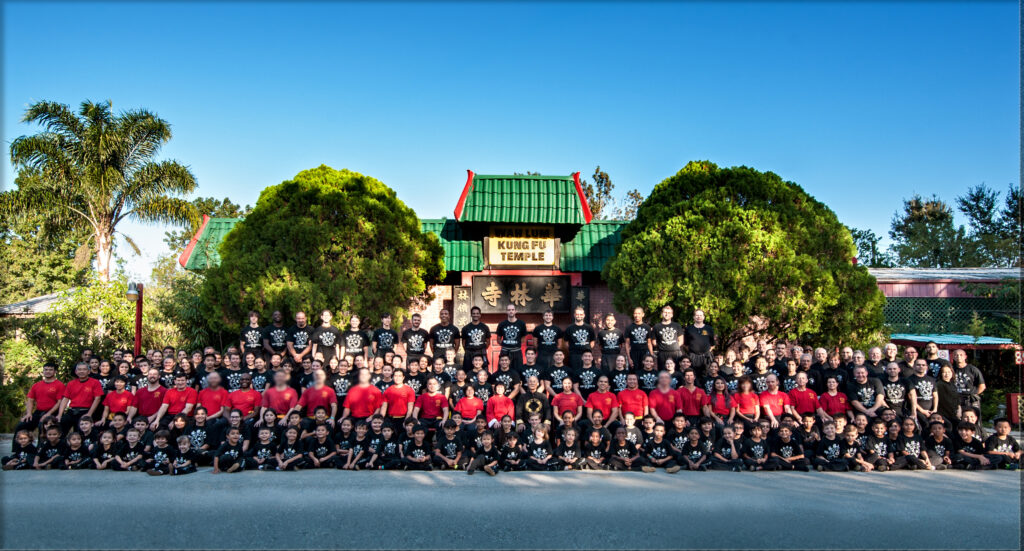
When you walk into the Temple, you see a sea of black uniforms (and some white, for our Tai Chi classes).

It looks professional, and it signifies that we are all part of the same team. But have you ever stopped to think about the deeper value of wearing the uniform?

On the surface, the benefit is obvious: Simplicity.

You don’t have to waste mental energy deciding what to wear to class. You don’t have to worry if your outfit matches or if it’s appropriate for training. You simply grab your uniform, and you are ready. But this simplicity unlocks something much more powerful.

“What we compress, expands.”

Renowned strength coach and author Dan John uses this phrase to explain the hidden benefits of uniformity. It begs the question: By “compressing” our choices of what to wear, does our training actually expand?

We believe the answer is yes.

When we remove the distraction of designer logos, expensive shoes, and fashion statements, we strip away the superficial. When everyone wears the same thing, we stop looking at the outfit and start seeing the human person.

By compressing the external variables, we expand what truly matters:

  • We notice the intellect and ideas: We focus on the students’ questions and their understanding of our martial art.
  • We notice the quality of work: Without the distraction of what you are wearing, the focus shifts entirely to how you are moving.
  • We expand our focus: Your mental energy isn’t on how you look; it is on your stances, your power, and your spirit.

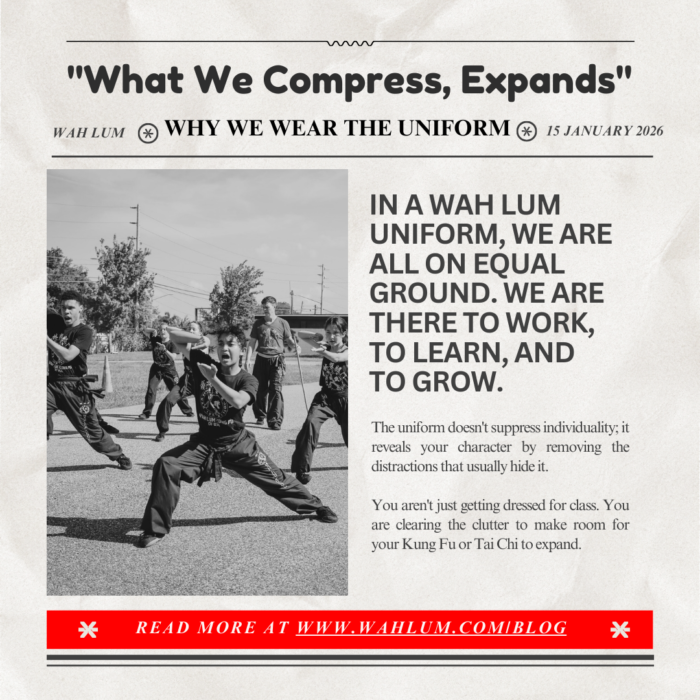
In a Wah Lum uniform, we are all on equal ground. We are there to work, to learn, and to grow.

The uniform doesn’t suppress individuality; it reveals your character by removing the distractions that usually hide it.

So, the next time you put on your uniform, remember: You aren’t just getting dressed for class. You are clearing the clutter to make room for your Kung Fu or Tai Chi to expand.

See you in training,

Sifu Oscar

wah lum kung fu temple


P.S. Ready to join the team? Training Kung Fu or Tai Chi is easier when your daily habits line up with your goals. Our Control System: Foundations is a 21-day remote program designed to simplify your nutrition and movement habits so you are ready to train. Email back with Foundations if you’re ready

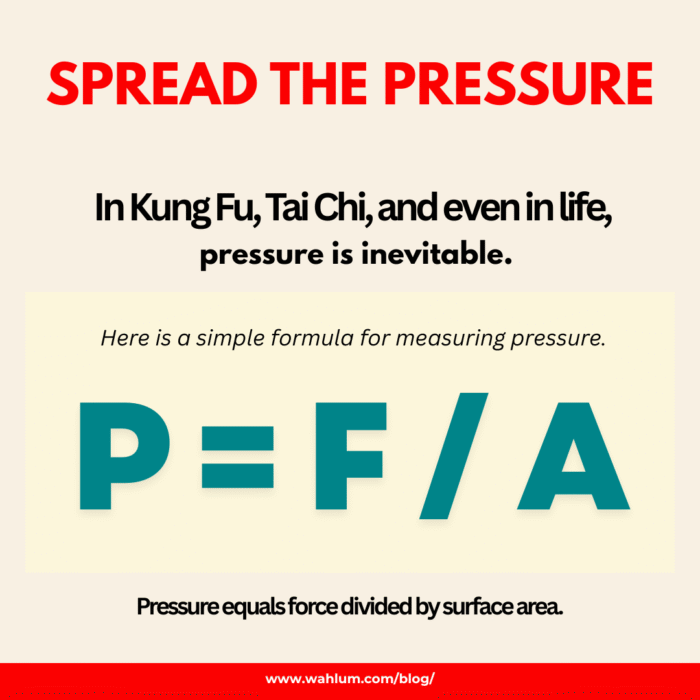
Spread the Pressure

In Kung Fu, Tai Chi, and even in life, pressure is inevitable.

Strategist Lulu Cheng has a formula for measuring pressure: P = F / A — Pressure equals force divided by surface area.

If the same amount of force hits a wide surface, the pressure is low. But if that same force is concentrated into a single point — like a needle — it can pierce through anything.

It’s the same in combat and in daily life.

A wide stance, a solid structure, or a connected team spreads out the pressure. But if you’re alone or too narrow in focus, even a small, focused force can break you.

When life pushes hard, we might not be able to change the force coming at us — but we can widen our surface area.

Lean on your training partners. Ask for help. Connt with your community. Or simply take a step away and do some deep breathing.

That’s the benefit of being part of the Wah Lum family — we don’t face challenges alone. (Have you read my post on The Wah Lum Conspiracy?)

Mental and physical attacks, setbacks, and goals are all shared and supported by the people training beside you.

But when you’re the one applying force? That’s when precision matters. Be focused, specific, intentional — like the tip of that needle. That’s how you make an impact.

Remember, everything meaningful in life involves others. Nothing profound is achieved in isolation.

So when you’re feeling overwhelmed or anxious — take action. Move. Help someone.

Because action absorbs anxiety, and connection spreads the pressure.

See you in training,

Sifu Oscar


P.S. Feeling stuck? Build Momentum. Small, consistent action turns pressure into progress. Join our next cycle and keep moving forward. Reply with Momentum and I’ll get you started.


P.P.S. Whenever you’re ready, here are ways we can help you get started.

1. Schedule a time to observe a class.
Interested in Kung Fu or Tai Chi?  First step is to watch a class and see if we would be a good fit! Email: kungfu@wahlum.com for an appointment.

2. Become part of my exclusive Coaching Group with CYH Remote Coaching.  Get personalized coaching delivered right to your phone and catered to your specific goals.
Email: kungfu@wahlum.com for info.

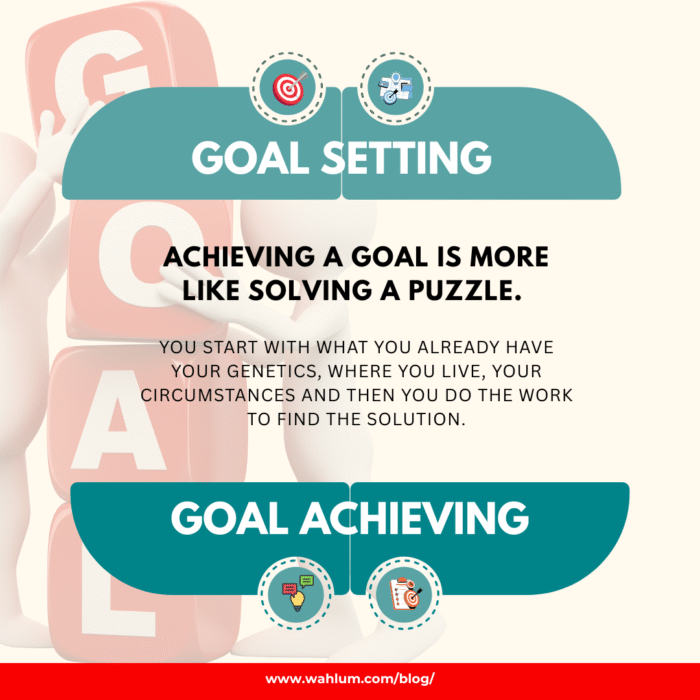
Goal Setting vs Goal Achieving

Dan John makes an important distinction between goal setting and goal achieving. Setting a goal can feel like daydreaming. 

Achieving a goal is more like solving a puzzle. 

You start with what you already have—your genetics, where you live, your circumstances—and then you do the work to find the solution.

One of the tools he uses is called the 5/2 plan. Ask yourself these five questions about your future:

  • What do you want in two decades?
  • In two years?
  • In two months?
  • Tomorrow?
  • Today?

If those questions feel overwhelming, you can also start with the opposite. Instead of asking what you want, ask what you don’t want. 

Dan John has a term for this that I’ve renamed for this newsletter: Reverse Goals. The idea is simple. When you catch yourself doing something that does not serve you, the lesson is, I am not going to do that again.

This is how we avoid being pulled into the latest fitness fad or quick-fix promise. 

Instead, we keep coming back to the fundamentals, the same way we return to basics in Kung Fu and Tai Chi:

  • Eat the right amount for your body each day.
  • Get enough protein to support recovery and strength.
  • Train with weights 2–3 times a week, just as we train our forms.
  • Walk more (I aim for 10,000 steps a day).
  • Sleep enough so the body and mind can recharge.

Add flossing and a yearly check-up, and you have a strong foundation. Not fancy, but it works.

This week, take a moment to answer those five questions for yourself. Then, choose one simple habit from the list above and give it your focus. 

Daydreams turn into progress when we put them into practice.

See you in training,

Sifu Oscar


P.S. Whenever you’re ready, here are ways we can help you get started.

1. Schedule a time to observe a class.
Interested in Kung Fu or Tai Chi?  First step is to watch a class and see if we would be a good fit! Email: kungfu@wahlum.com for an appointment.

2. Become part of my exclusive Coaching Group with CYH Remote Coaching.  Get personalized coaching delivered right to your phone and catered to your specific goals.
Email: kungfu@wahlum.com for info.

Use Your Strengths

Do you know what your strengths are?

Not just what you’re good at- but what energizes you.
What puts you in the zone. What makes time fly.
What you’d do again, even if no one was watching. 


Your Strengths Are Your Responsibility

Those strengths? They’re not accidents. They’re assignments. 

Your gifts were given to be used.

They’re not just strengths—they’re responsibilities. Our purpose in life is tied to how we contribute them.


Why It Matters:

Too often, we obsess over our flaws. But that voice that says “you’re not good enough” is not new.

It’s not helpful. And honestly, it’s kind of boring. 

Your strengths are more interesting.
They speak to who you are and who you’re becoming.

Strengths aren’t just what you’re good at.They’re the things that energize and strengthen you—even if you’re not good at them… yet.


What To Do:

  • Focus on the activities that you want to do again (hopefully Kung Fu or Tai Chi!).
  • Don’t confuse talent with passion. 
  • Forget the external “adornments”—titles, —and focus on the activity itself.
  • Practice what you love. Your appetite will lead you to mastery.

And remember: nothing great is done alone.

Your strengths grow stronger in community. That’s what we’re building here at Wah Lum.

Keep practicing. Keep contributing. Keep becoming who you’re meant to be.

Control Corner 25 from Sifu Oscar: The Mirror of Mastery

At Wah Lum, the flipped Chinese character for ‘Fire’ reminds us that control is the key to mastering life’s challenges. Welcome to the Control Corner, where we share weekly wisdom to help you unlock your potential.

Essentials: Mastery begins with self-awareness. In West with the Night, author Beryl Markham reflects on how we spend our lives studying others while often remaining strangers to ourselves. As a pilot, alone in the vast night sky, she discovered the power of self-observation—an essential skill in both life and martial arts.

Why It Matters: True progress isn’t just about watching and learning from others; it’s about turning that focus inward. In martial arts, we often want to rush to advanced techniques, but true skill comes from refining the basics with patience and awareness. Just as Markham had to master small skills before flying solo, every stance, every movement, every breath is an opportunity for deeper understanding.

What’s Next: This week, be your own observer. Set aside time to train alone, focusing on the fundamentals with fresh eyes. What do you discover when you’re fully present with yourself? Mastery isn’t just about learning more—it’s about seeing more in what you already know.

Here is a small excerpt from the book West with the Night by Beryl Markham that inspired this post. 

“You can live a lifetime and, at the end of it, know more about other people than you know about yourself. You learn to watch other people, but you never watch yourself because you strive against loneliness. 

If you read a book, or shuffle a deck of cards, or care for a dog, you are avoiding yourself. The abhorrence of loneliness is as natural as wanting to live at all. If it were otherwise, men would never have bothered to make an alphabet, not to have fashioned words out of what were only animal sounds, not to have crossed continents – each man to see what the other looked like. 

Being alone in an aeroplane for even so short a time as a night and a day, irrevocably alone, with nothing to observe but your instruments and your own hands in semi-darkness, nothing to contemplate but the size of your small courage, nothing to wonder about but the beliefs, the faces, and the hopes rooted in your mind – such an experience can be as startling as the first awareness of a stranger walking by your side at night. You are the stranger.”

Control Corner 23 with Sifu Oscar: The Power of Thinking

Welcome to the Control Corner, your weekly dose of wisdom on mastering control in martial arts, health, and life. At Wah Lum, the flipped Chinese character for ‘Fire’ represents control—an idea central to everything we do. 

Let’s explore how focusing on what matters can help you reach your full potential.

Essentials: Throughout history, deep thinking has powered successful people. It’s not about thinking more, but thinking better. Taking just a moment to reflect—whether through Kung Fu, Tai Chi, reading, or time in nature—can unlock insights that shape your path.

Why It Matters: When you pause and truly listen to yourself, you gain clarity about your goals, your challenges, and your aspirations. The strongest traditions, the ones that have stood the test of time, are the ones that encourage deeper thinking. Success isn’t just about working harder—it’s also about thinking just a bit deeper.

What’s Next: In today’s world, focus is the new IQ. Those who cultivate the ability to concentrate without distraction will thrive. Give yourself space to think—slow down during forms, focus on your breath, or take a mindful moment after training.

As Bruce Lee said, “To become different from what we are, we must have some awareness of what we are.” The more you cultivate thoughtful awareness, the more you’ll see old ideas in new ways—and that’s where true growth happens.


P.S. Whenever you’re ready, here are ways we can help you get started.

1. Schedule a time to observe a class.
Interested in Kung Fu or Tai Chi?  First step is to watch a class and see if we would be a good fit! Email: kungfu@wahlum.com for an appointment.

2. Become part of my exclusive Coaching Group with CYH Remote Coaching.  Get personalized coaching delivered right to your phone and catered to your specific goals. Email: kungfu@wahlum.com for info.