What Sei Ping Ma Really Means

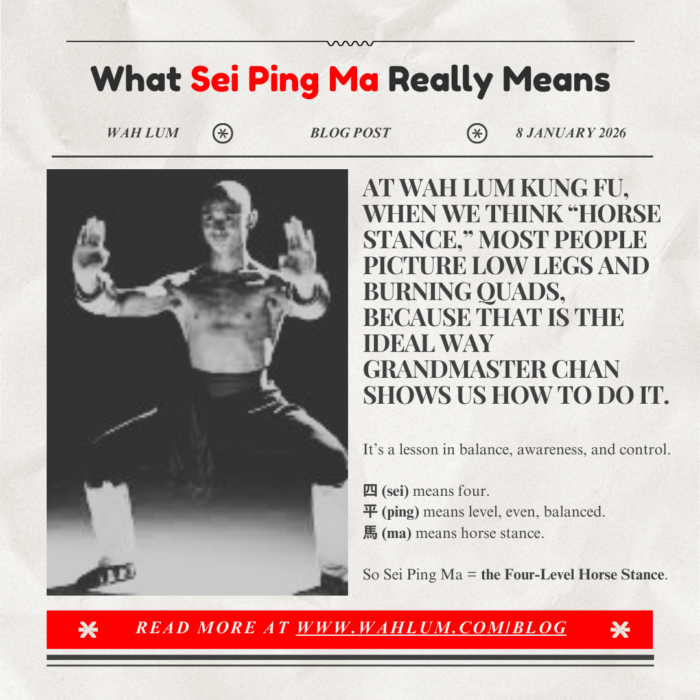
At Wah Lum Kung Fu, when we think “horse stance,” most people picture low legs and burning quads, because that is the ideal way Grandmaster Chan shows us how to do it. 

Let’s break down the meaning of Sei Ping Ma (四平馬) so we can see that it is more than just a posture or basic stance.

It’s a lesson in balance, awareness, and control.

四 (sei) means four.

平 (ping) means level, even, balanced.

馬 (ma) means horse stance.

So Sei Ping Ma = the Four-Level Horse Stance.

Why “four”?

Because the stance teaches you to level and align the four main checkpoints of the body:

  • shoulders
  • hips
  • knees
  • feet

From above, the stance creates a square. From within, it builds evenness. If you study the Chinese character for the number four, you’ll see the structural similarity.

In our Kung Fu practice, this stance teaches you how to root, breathe, and stay centered even when the legs get tired. It’s both a martial arts stance and a practice of staying balanced in all four directions. 

You can also see your mobility (ankles, hips, and thoracic spine) revealed in how well you can hold this stance.

For our extra-mobile students: a strong Sei Ping Ma isn’t about how low you go, it’s about how level you stay.

How Tai Chi Differs

In Tai Chi, our open stance is a horse stance, or Ma Bo, but at a slightly higher elevation. Tai Chi emphasizes softness, relaxation, and ease, so Sei Ping Ma’s structure and tension would be counter to what we’re trying to accomplish in Tai Chi practice.

Cantonese Terms

  • Horse stance: Ma Bo (馬步)
  • Sei Ping Ma: Sei Ping Ma (四平馬)

How’s your horse stance training going lately? Next time you drop 

into Sei Ping Ma, check those four checkpoints and see what your body is telling you.

See you in training, 

Sifu Oscar


P.S. Feel like your hips or knees are too stiff to hold a stance? You can fix that from home. I have a remote coaching program called Active Mobility designed to help you build the flexibility and strength you need for life (and Kung Fu). Email kungfu@wahlum.com with MOBILITY and we’ll send you the info.
Spread the Pressure

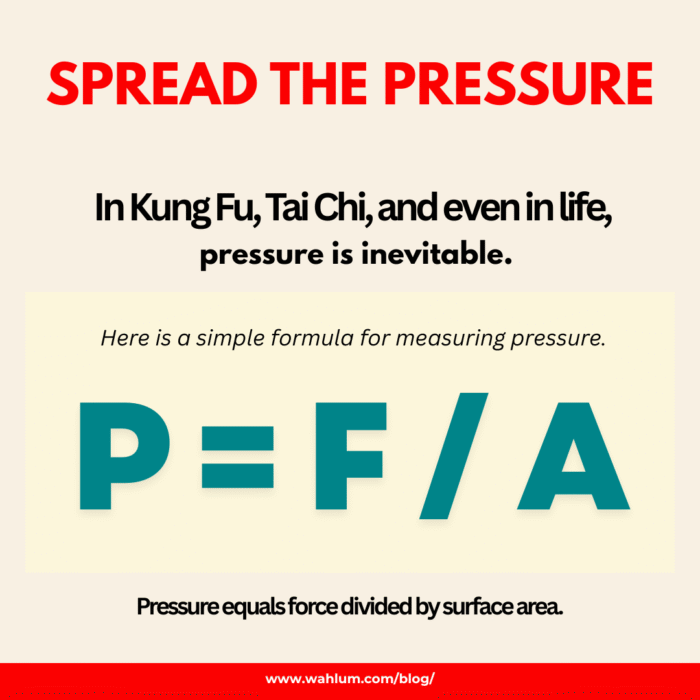
In Kung Fu, Tai Chi, and even in life, pressure is inevitable.

Strategist Lulu Cheng has a formula for measuring pressure: P = F / A — Pressure equals force divided by surface area.

If the same amount of force hits a wide surface, the pressure is low. But if that same force is concentrated into a single point — like a needle — it can pierce through anything.

It’s the same in combat and in daily life.

A wide stance, a solid structure, or a connected team spreads out the pressure. But if you’re alone or too narrow in focus, even a small, focused force can break you.

When life pushes hard, we might not be able to change the force coming at us — but we can widen our surface area.

Lean on your training partners. Ask for help. Connt with your community. Or simply take a step away and do some deep breathing.

That’s the benefit of being part of the Wah Lum family — we don’t face challenges alone. (Have you read my post on The Wah Lum Conspiracy?)

Mental and physical attacks, setbacks, and goals are all shared and supported by the people training beside you.

But when you’re the one applying force? That’s when precision matters. Be focused, specific, intentional — like the tip of that needle. That’s how you make an impact.

Remember, everything meaningful in life involves others. Nothing profound is achieved in isolation.

So when you’re feeling overwhelmed or anxious — take action. Move. Help someone.

Because action absorbs anxiety, and connection spreads the pressure.

See you in training,

Sifu Oscar


P.S. Feeling stuck? Build Momentum. Small, consistent action turns pressure into progress. Join our next cycle and keep moving forward. Reply with Momentum and I’ll get you started.


P.P.S. Whenever you’re ready, here are ways we can help you get started.

1. Schedule a time to observe a class.
Interested in Kung Fu or Tai Chi?  First step is to watch a class and see if we would be a good fit! Email: kungfu@wahlum.com for an appointment.

2. Become part of my exclusive Coaching Group with CYH Remote Coaching.  Get personalized coaching delivered right to your phone and catered to your specific goals.
Email: kungfu@wahlum.com for info.

Longevity Training: Staying Strong in Kung Fu and Tai Chi After 56

Lately I have been thinking about what my training will look like 10 years from now, when I am over 56. At that stage, my priorities will shift. 

The goal will not be chasing personal records or max lifts. The goal will be staying strong, mobile, and consistent so I can keep practicing Kung Fu and Tai Chi.

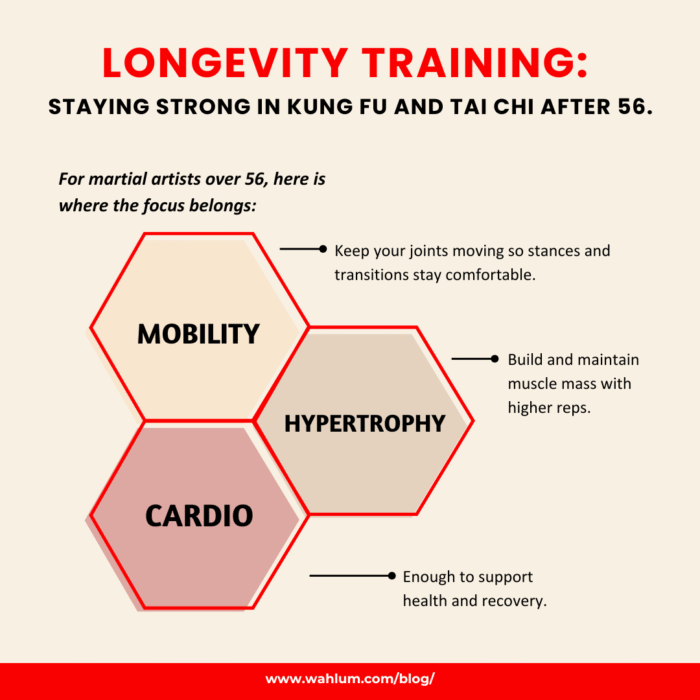
For martial artists over 56, here is where the focus belongs:

  • Mobility: keep your joints moving so stances and transitions stay comfortable.
  • Hypertrophy: build and maintain muscle mass with higher reps. This does not have to mean machines — kettlebells, bodyweight movements, bands, and light dumbbells are all excellent options.
  • Cardio: enough to support health and recovery. This can be as simple as practicing forms at a faster pace with good control, or walking daily.

After 56, it is less about maxing out and more about staying consistent with quality movement. 

Show up, move, breathe, keep the reps high, and release tension between sets. 

In Kung Fu and Tai Chi, that might mean practicing stances, transitions, and balance drills with steady repetition until they feel effortless.

The key is to keep going. Keep training. Keep showing up.

See you in training,

Sifu Oscar


P.S. The principle of stretching what is stiff and strengthening what is weak starts on day one. That is what our Foundations program is all about. Reply with Foundations and I will get you started.


P.P.S. Whenever you’re ready, here are ways we can help you get started.

1. Schedule a time to observe a class.
Interested in Kung Fu or Tai Chi?  First step is to watch a class and see if we would be a good fit! Email: kungfu@wahlum.com for an appointment.

2. Become part of my exclusive Coaching Group with CYH Remote Coaching.  Get personalized coaching delivered right to your phone and catered to your specific goals.
Email: kungfu@wahlum.com for info.

Push, Pull, and the Lessons of Middle Age

In your late teens and 20s, the choices you make with food and training will stay with you. Strength coach Mike Boyle shared the best advice I know when it comes to body composition, and it is especially true in your 20s. 

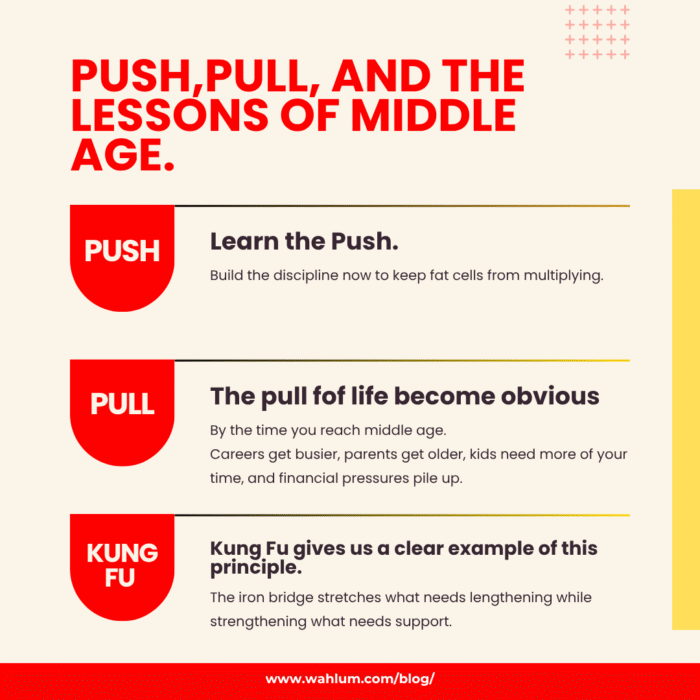
Learn the Push. 

Push the table away. Push the extra beer and pizza away. 

Build the discipline now to keep fat cells from multiplying.

Why? Because once you create fat cells, they don’t just disappear. Fat cells act like balloons. When you overeat, it is like blowing air into the balloon and it expands. 

When you train, eat better, and lose fat, you don’t pop the balloon. You simply let the air out. It shrinks, but it never disappears. 

That is why learning the skill of Push early is so valuable. But even if you did not learn it in your 20s, it is not too late. 

The ability to push away what does not serve you is a practice you can strengthen at any age.

By the time you reach middle age, the Pulls of life become more obvious. 

Careers get busier, parents get older, kids need more of your time, and financial pressures pile up. At the same time, your body starts sending reminders — tighter hips, rounded shoulders, slower recovery. 

Strength coach Dan John sums up the solution perfectly: Stretch what’s stiff. Strengthen what’s weak. For most of us, that means:

  • Stretch: hip flexors, hamstrings, pecs, biceps
  • Strengthen: glutes, ab wall, deltoids, triceps

Over six years ago, Sifu Mimi and I started a video blog series called 40 Fit-Fu. We recorded more than 100 episodes on training, nutrition, and health. 

If you scroll to the bottom of the playlist, you will find our final episodes where we looked back at the first ones and shared how our approach has evolved. 

Training is a lifelong process. What works at 20 might not be what you need at 40, and what you build at 40 sets you up for your 60s.

Kung Fu gives us a clear example of this principle. 

The iron bridge stretches what needs lengthening while strengthening what needs support. 

It is also a classic Push-Pull exercise: pushing the hips up, pulling the shoulders back. That combination is exactly what keeps us strong, mobile, and balanced through every stage of life.

See you in training,

Sifu Oscar


P.S. The principle of stretching what is stiff and strengthening what is weak starts on day one. That is what our Foundations program is all about. This is also remote coaching through our app, with daily actions and accountability built in. Reply with Foundations and I will get you started.


P.P.S. Whenever you’re ready, here are ways we can help you get started.

1. Schedule a time to observe a class.
Interested in Kung Fu or Tai Chi?  First step is to watch a class and see if we would be a good fit! Email: kungfu@wahlum.com for an appointment.

2. Become part of my exclusive Coaching Group with CYH Remote Coaching.  Get personalized coaching delivered right to your phone and catered to your specific goals.
Email: kungfu@wahlum.com for info.

Feedback That Builds Skill

One of the benefits of training at Wah Lum is the coaching team. You are surrounded by instructors who are constantly checking in, correcting, and encouraging. 

That means you are never left wondering if you are on the right path. You are getting feedback in real time.

Think about school. A single high-stakes test like the SAT gives a snapshot of how you performed on one day under stress. It does not define your intelligence or your potential. 

Research shows that frequent, low-stakes quizzes are much better. They provide more opportunities to learn, reduce pressure, and give a clearer picture of growth over time.

Kung Fu and Tai Chi training work the same way. 

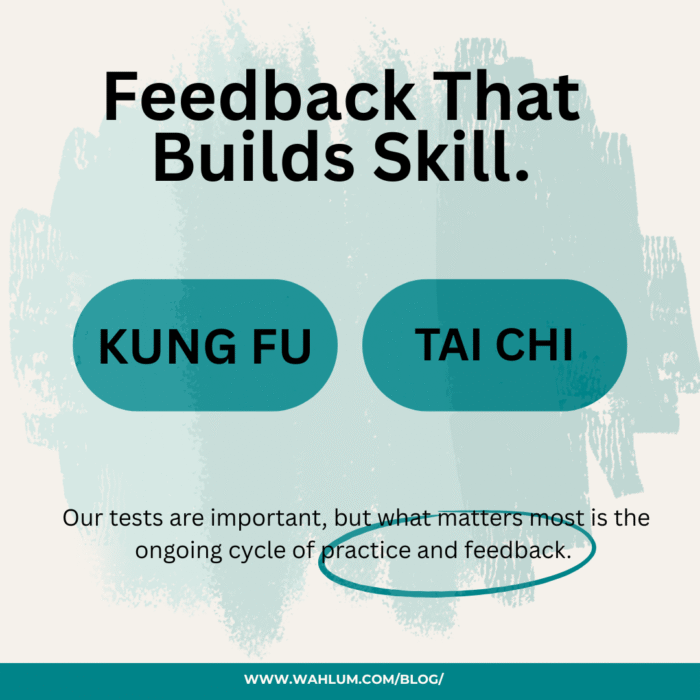
Our tests are important, but what matters most is the ongoing cycle of practice and feedback. 

Every class is like a quiz. Every correction from a Sifu or Si Hing or Si Jye is another chance to improve. The result is steady progress that builds confidence without the weight of one stressful moment.

It is also important to remember that feedback is not criticism. Sometimes you will get detailed, specific instruction. Other times you may not get as much, and that is your opportunity to check in on yourself. 

Both are part of learning.

Action Step: This week, take one piece of feedback from your teacher, big or small, and make it your focus in every class. 

Notice how steady attention to a single detail can accelerate your growth.

Mastery comes from consistent effort, clear guidance, and the support of a strong community. At Wah Lum, that is what you receive every time you step on the floor.

See you in training,

Sifu Oscar


P.S. Whenever you’re ready, here are ways we can help you get started.

1. Schedule a time to observe a class.
Interested in Kung Fu or Tai Chi?  First step is to watch a class and see if we would be a good fit! Email: kungfu@wahlum.com for an appointment.

2. Become part of my exclusive Coaching Group with CYH Remote Coaching.  Get personalized coaching delivered right to your phone and catered to your specific goals.
Email: kungfu@wahlum.com for info.

The Secret to Lasting Progress

One of the hardest lessons in training is patience. Real strength takes time. It takes at least six weeks before the body even begins to adapt. 

What feels like progress early on is often just your nervous system getting better at the movement. That is not wasted time, it is practice, but it is not true strength yet.

This is why frustration is part of the path. Every elite athlete has had to learn it. You will not feel progress every day. 

If excellence were easy, everyone would achieve it.

Most people give up simply because they expect too much too soon. They confuse the normal ups and downs of training with failure. 

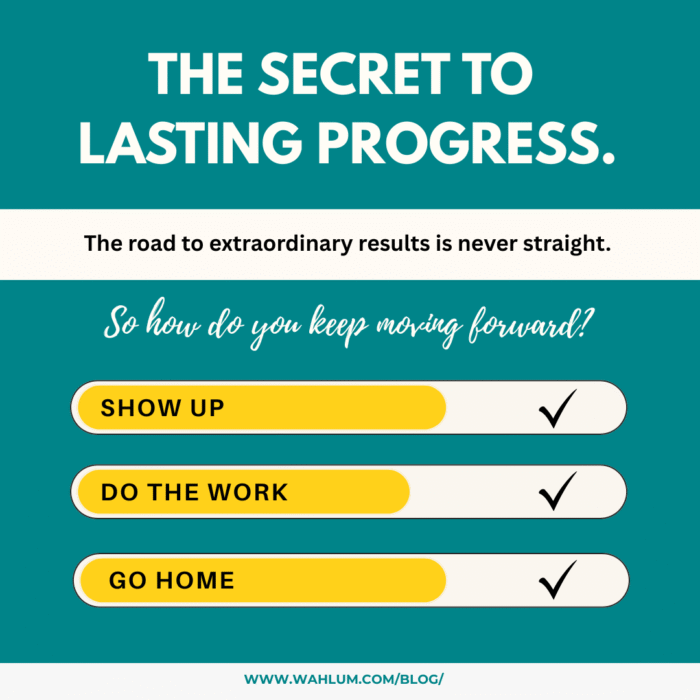
The road to extraordinary results is never straight.

So how do you keep moving forward?

  • Show up.
  • Do the work.
  • Go home.

Progress comes from a steady work ethic paired with determination. Once you decide on your goal, stick with it. Do not compromise.

True progress requires long-term focus. No drama. No beating yourself up over small setbacks. 

Learn to enjoy the process, because you will spend far more time on the journey than in those brief moments of victory.

Celebrate the wins when they come. Learn from the defeats. 

And remember, if you are never failing, you are not pushing hard enough.

Most importantly, forget the timeline. It will take as long as it takes. Make the decision once and stay committed. That single choice is more powerful than any shortcut.

Kung Fu itself means hard work over time. 

At Wah Lum, our art reminds us that mastery is not about quick fixes. It is about patience, perseverance, and refusing to settle for less than your best.

See you in training,

Sifu Oscar


P.S. Whenever you’re ready, here are ways we can help you get started.

1. Schedule a time to observe a class.
Interested in Kung Fu or Tai Chi?  First step is to watch a class and see if we would be a good fit! Email: kungfu@wahlum.com for an appointment.

2. Become part of my exclusive Coaching Group with CYH Remote Coaching.  Get personalized coaching delivered right to your phone and catered to your specific goals.
Email: kungfu@wahlum.com for info.

Managing Force, Not Absorbing It

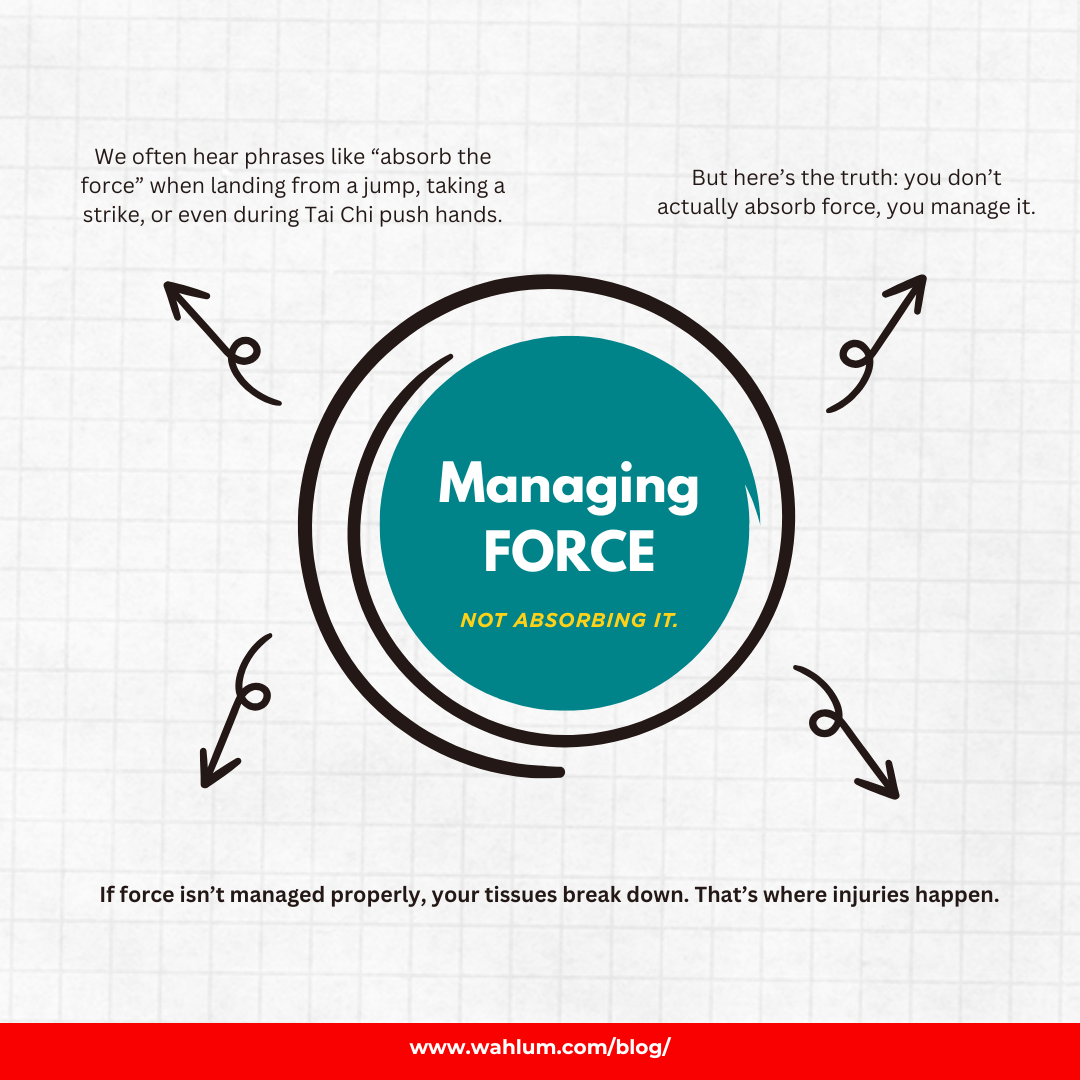
We often hear phrases like “absorb the force” when landing from a jump, taking a strike, or even during Tai Chi push hands. But here’s the truth: you don’t actually absorb force, you manage it.

If force isn’t managed properly, your tissues break down. That’s where injuries happen.

Newton’s 3rd Law reminds us: for every action, there is an equal and opposite reaction. When your foot hits the ground, the ground pushes back with equal force. This is called ground reaction force—and it’s something we must learn to control.

In Kung Fu, especially when we practice jumps, our ability to manage these forces makes all the difference. Here’s what the body deals with every time we move:

  • Walking: 1–1.5 × your bodyweight
  • Running: 2–2.9 × your bodyweight
  • Jumping: up to 7 × your bodyweight

Think about that. A 150-pound person landing from a jump could be managing over 1,000 pounds of force!

In Tai Chi, we practice the same principle in a softer way through push hands. Instead of letting force overwhelm us, we redirect, root, and return it. The skill is not in stopping force, but in managing where it goes.

Whether you’re landing from a Kung Fu jump or feeling pressure in Tai Chi push hands, the lesson is the same: force must be managed. 

Strong stances, mindful practice, and controlled movements keep our bodies safe and our training sustainable.

This week in class, pay attention to how you land, how you root, and how you redirect energy. 

That’s where control and resilience are developed

See you in training,

Sifu Oscar


P.S. Whenever you’re ready, here are ways we can help you get started.

1. Schedule a time to observe a class.
Interested in Kung Fu or Tai Chi?  First step is to watch a class and see if we would be a good fit! Email: kungfu@wahlum.com for an appointment.

2. Become part of my exclusive Coaching Group with CYH Remote Coaching.  Get personalized coaching delivered right to your phone and catered to your specific goals.
Email: kungfu@wahlum.com for info.

Goal Setting vs Goal Achieving

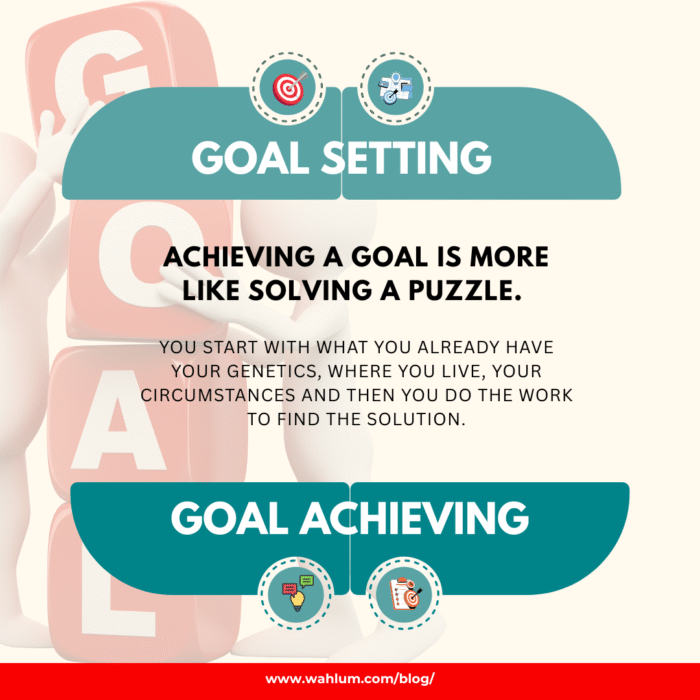
Dan John makes an important distinction between goal setting and goal achieving. Setting a goal can feel like daydreaming. 

Achieving a goal is more like solving a puzzle. 

You start with what you already have—your genetics, where you live, your circumstances—and then you do the work to find the solution.

One of the tools he uses is called the 5/2 plan. Ask yourself these five questions about your future:

  • What do you want in two decades?
  • In two years?
  • In two months?
  • Tomorrow?
  • Today?

If those questions feel overwhelming, you can also start with the opposite. Instead of asking what you want, ask what you don’t want. 

Dan John has a term for this that I’ve renamed for this newsletter: Reverse Goals. The idea is simple. When you catch yourself doing something that does not serve you, the lesson is, I am not going to do that again.

This is how we avoid being pulled into the latest fitness fad or quick-fix promise. 

Instead, we keep coming back to the fundamentals, the same way we return to basics in Kung Fu and Tai Chi:

  • Eat the right amount for your body each day.
  • Get enough protein to support recovery and strength.
  • Train with weights 2–3 times a week, just as we train our forms.
  • Walk more (I aim for 10,000 steps a day).
  • Sleep enough so the body and mind can recharge.

Add flossing and a yearly check-up, and you have a strong foundation. Not fancy, but it works.

This week, take a moment to answer those five questions for yourself. Then, choose one simple habit from the list above and give it your focus. 

Daydreams turn into progress when we put them into practice.

See you in training,

Sifu Oscar


P.S. Whenever you’re ready, here are ways we can help you get started.

1. Schedule a time to observe a class.
Interested in Kung Fu or Tai Chi?  First step is to watch a class and see if we would be a good fit! Email: kungfu@wahlum.com for an appointment.

2. Become part of my exclusive Coaching Group with CYH Remote Coaching.  Get personalized coaching delivered right to your phone and catered to your specific goals.
Email: kungfu@wahlum.com for info.

Finding Your “Why” in Training

What makes you Tick?

I’ve been thinking a lot about how to make real progress in training. This applies to any pursuit, but for me, it’s mostly Kung Fu, Tai Chi, and strength training.

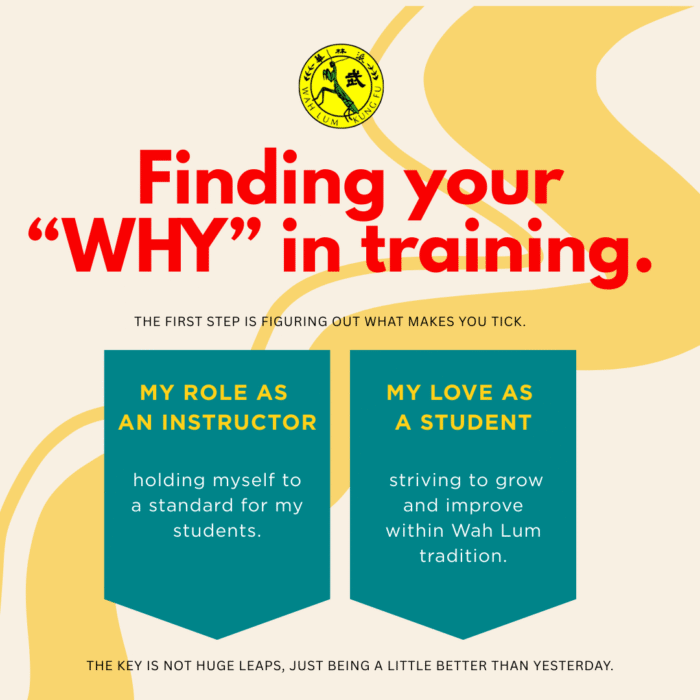
The first step is figuring out what makes you tick. What keeps you putting in effort consistently; through the tough days, weeks, and years? What’s your why?

For me, it’s two things:

  • My role as an instructor, holding myself to a standard for my students.
  • My love as a student, striving to grow and improve within Wah Lum tradition.

Another tool that’s helped me, especially in strength training, is writing things down. Sets, reps, weights, and notes on how I felt. Keeping track makes it clear that even when I feel stuck, I am progressing.

I don’t do this enough in Kung Fu and Tai Chi. Sure, I can see I’ve learned more forms and techniques, but quantity doesn’t equal quality. I could track martial intent, smoothness, endurance; maybe even score myself 1–10.

My plan? Before each training session, open my journal, review the last session, and decide one small way I’ll beat my past self. The key is not huge leaps, just being a little better than yesterday.


See you in class,

Sifu Oscar


P.S. Whenever you’re ready, here are ways we can help you get started.

1. Schedule a time to observe a class.
Interested in Kung Fu or Tai Chi?  First step is to watch a class and see if we would be a good fit! Email: kungfu@wahlum.com for an appointment.

2. Become part of my exclusive Coaching Group with CYH Remote Coaching.  Get personalized coaching delivered right to your phone and catered to your specific goals.
Email: kungfu@wahlum.com for info.

Kung Fu, Tai Chi, Steps, and the Other 165 Hours of Your Week

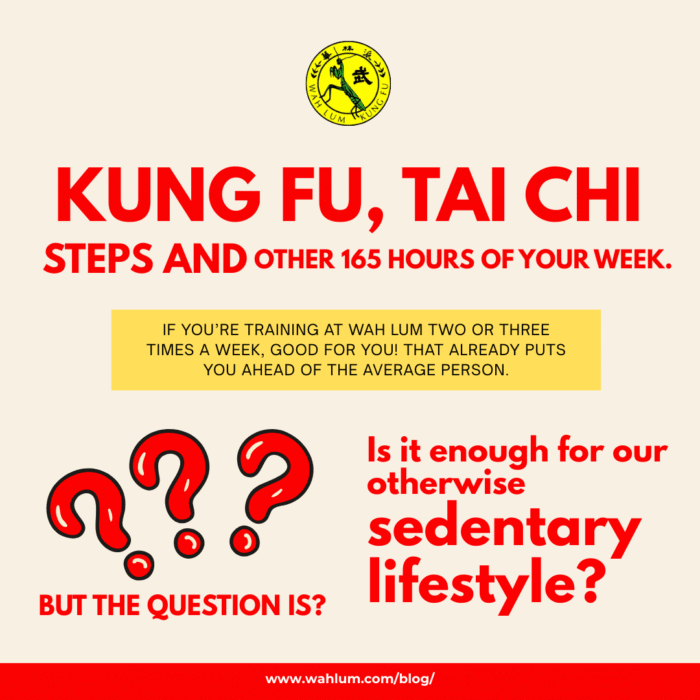
If you’re training at Wah Lum two or three times a week, good for you! That already puts you ahead of the average person. But here’s a question: is it enough for our otherwise sedentary lifestyle?

There are 168 hours in a week. Even with three intense classes, that still leaves 165 hours to fill. What are you doing with the rest of your time?

A few months ago, I read strength coach Dan John’s experience with walking 10,000 steps a day. He credited that simple habit (not an extreme workout plan) with helping him get lean and stay lean. Inspired, I bought a $15 pedometer for a 30-day experiment. I chose an inexpensive one for two reasons:

  • Studies suggest basic pedometers can be more accurate than fancy phones.
  • I didn’t want to rely on my phone or invest in a high-tech watch for a short trial.

It turns out that walking 10,000 steps is not a new concept. The idea gained popularity in Japan during the lead-up to the 1964 Tokyo Olympics, when a pedometer brand called manpo-kei (literally “10,000 steps meter”) used the number as a catchy marketing tool. While the number wasn’t based on science at the time, modern research shows it’s a pretty good daily target for overall health.

Here’s what I learned from my own trial:

  • Hitting 10,000 steps was harder than I thought unless I planned for it.
  • Kung Fu and strength training alone didn’t get me there, even if I did both on the same day.
  • Yard work easily pushed me past the goal, as did a 45–60 minute walk with my mom on Sundays.
  • On most other days, I had to intentionally add movement to hit the target.

One interesting side effect: when I hit 10,000 steps or more, I felt pleasantly tired and wanted to go to bed earlier. That alone felt like a win.

I also realized I didn’t need to wear the pedometer all day. Instead, I put it on only when I was going to move outside of Kung Fu or strength training, such as during walks or yard work. This way, my steps were “true” additional movement, not just my daily total. Even hitting 5,000–8,000 intentional steps this way felt beneficial.

Walking might not sound as exciting as throwing kicks or moving weights around, but it’s a simple, proven way to add more movement to your life. So, the next time you think about your training, remember: it’s not just about the three hours a week you spend at the Temple, it’s about the other 165 hours too.

-Sifu Oscar