Manipulate vs. Motivate (Whose job is it?)

There are two words that are confused in leadership and teaching, but understanding the difference can change how you approach your training:

Manipulate and Motivate.

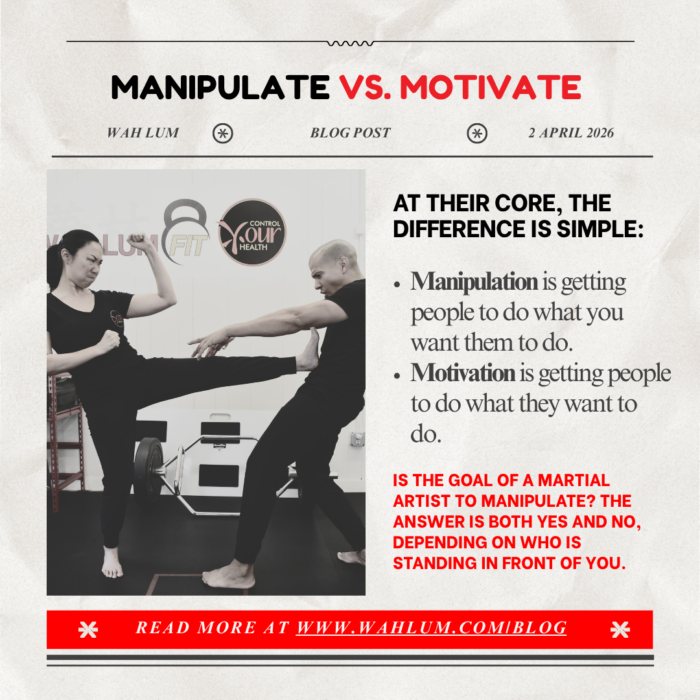
At their core, the difference is simple:

  • Manipulation is getting people to do what you want them to do.
  • Motivation is getting people to do what they want to do.

Is the goal of a martial artist to manipulate? The answer is both yes and no, depending on who is standing in front of you.

When to Manipulate (The Opponent & The Body)

In the physical realm of Kung Fu or Tai Chi, manipulation is a requirement.

If I am facing an opponent, one goal is physical and psychological manipulation. I want to draw them off balance. I want them to react to a feint so I can open a line of attack. I am trying to get them to do exactly what I want them to do.

As a teacher, I also use physical manipulation with students. When I physically adjust posture, correct a stance, or move an arm into the proper angle for a block, I am manipulating a body to show the correct path.

When to Motivate (The Student & The Mind)

But when it comes to the mental game of teaching students, leading and learning from my martial arts family, manipulation fails.

I cannot trick a student into being disciplined. I cannot manipulate you into loving the art or putting in the hours of practice when no one is watching. If I force a student to train, they are doing it for me at that moment. That isn’t sustainable.

A good teacher (and always a student first) must have the ability to manipulate the body, but the skill to motivate the mind.

One goal as a teacher is to provide tactical insight that is specific enough to make you think. That is motivation and something that is harder to do. Example: my constant failures at motivating students!

Your Job: Manipulating The Variables

Here is where the two concepts meet.

I can attempt to motivate your mind, and I can physically manipulate your body to show you the standard. But eventually, you have to take ownership.

Motivation only sparks the fire. To be successful, you have to put in the work to apply the lesson. You must become a master of manipulating the variables in your life.

  • You have to manipulate your schedule to ensure you have time to train.
  • You have to manipulate your environment to remove distractions.
  • You have to manipulate your own stiff joints and tired muscles to do the work.

The instructors at the Temple will continue to work on providing the motivation. You have to execute the manipulation.

See you in training,

Sifu Oscar


P.S. Motivation gets you started. People wait for the perfect moment to start training, but the truth is, you have to manipulate your own schedule to make it happen. If you have the internal motivation to start but need a structured path to follow, here are two ways I can help:

  1. See it for yourself: The best way to understand Wah Lum is to see it in person. Comment with OBSERVATION and we will set up a time for you to come visit a class.
  2. Start from home: Comment with FOUNDATIONS and I’ll send you the details for our 21-day remote prep program.

Stop Competing With Your Ideal

I’ve been thinking a lot about the words we use, and how they shape our Kung Fu and Tai Chi training. There are two words that are often mixed up, and confusing them can mess with your progress:

Ideal and Optimal.

The Trap of the “Ideal”

The Ideal has to do with comparison.

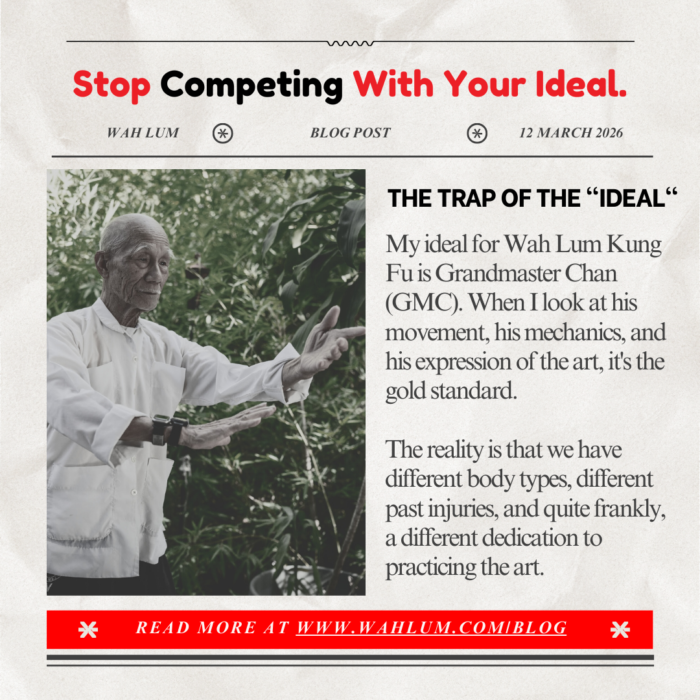
My ideal for Wah Lum Kung Fu is Grandmaster Chan (GMC). When I look at his movement, his mechanics, and his expression of the art, it’s the gold standard.

The reality is that we have different body types, different past injuries, and quite frankly, a different dedication to practicing the art.

For example, Sifu Tu is another ideal for me. When standing, we are different heights, but when sitting, we are the same height. Sifu Tu started at around 10 with full splits and a lot of focused training; I started in my 20s with shoulder injuries, overall stiffness, and exercise ADD (always having different training goals).

I can and do use GMC, Sifu Tu, or Sifu Mimi as ideals to motivate me and give me a North Star to aim for. 

But I will not compete with my ideal. 

Treating the ideal as the standard, I have to perfectly match every day, which places me in an external competition that I cannot win. I would constantly feel like I am falling short, which ultimately leads to deep disappointment and burnout.

The Power of the “Optimal”

Your optimal self is not a fantasy version of you. It isn’t even the best you hope to be five years from now.

Your Optimal is the best you can do today. Right now.

It’s the best you can do with the body you bring to the training floor today. With your current physical reality. With the stress you are carrying from work. With the sleep you got last night.

  • The Ideal is external comparison.
  • The Optimal is internal competition.

When you stop comparing yourself to the Ideal and start competing with yourself to find today’s Optimal, that is when true, sustainable improvement happens.

Preparing for the Unknown

This shift in mindset changes how we train.

We don’t train just to plan for one specific, “ideal” scenario, because in training, as in life, the ideal scenario rarely happens.

Instead, we prepare by building an optimal mindset. A mindset that doesn’t shatter when things aren’t perfect. A mindset that can handle uncertainty and still execute the best possible response with whatever tools are available in that exact moment.

Let the Ideal inspire you. Let the Optimal drive you.

See you in training,

Sifu Oscar


P.S. Stop waiting for the “ideal” time. People delay starting martial arts because they are waiting for the ideal time—when work slows down, when they lose 10 pounds, when life is less stressful. The ideal time is a myth. The optimal time is today, with your life exactly as it is. Here are 2 ways I can help:

  1. See it for yourself: The best way to understand Wah Lum is to see it in person. Comment with OBSERVATION, and we will set up a time for you to come visit a class.
  2. Start from home: Comment with IDEAL and I’ll send you the details for our 21-day Foundations program.

What Mozart Told the 21 Year Old

Hello Wah Lum Family,

There are two ways to climb a mountain.

You can start at the bottom and make every single mistake from scratch on your way to the top. Or, you can take a Sherpa with you and master the best of what others have already figured out.

We often hear that “mistakes are the best teachers.”

I don’t know about that.

Your mistakes aren’t the best teacher; they are just the most expensive. The successful learn by example; they learn from the experience of their Sifu and their seniors. The foolish insist on firsthand pain.

However, there is a trap here.

While you need a guide, you cannot rely solely on asking for directions. Advice is overrated, and action is underrated.

There is a story about Mozart that perfectly illustrates this point:

A young man asked Mozart how to write a symphony. Mozart replied, “You’re far too young to write a symphony.” The young man protested, “But you were writing symphonies when you were 10 years old, and I’m 21!”

Mozart smiled and replied, “Yes, but I didn’t go around asking people how to do it.”

You can read all the books, watch all the videos, and ask your Sifu every question in the book. But ultimately, advice-gathering can quickly become procrastination in disguise.

The Balance:

  1. Trust the Sherpa: Don’t try to reinvent the system. It has been refined for longer than you’ve been alive so you don’t have to make the “expensive mistakes.”
  2. Be like Mozart: Don’t just ask how to be good. Go train.

Take the advice, act on it, and adjust accordingly.

See you in training,

Sifu Oscar


P.S. There are 2 ways I can help you stop “advice gathering” and start taking action:

  1. See it for yourself: The best way to understand the system is to see it in person. Email us kungfu@wahlum.com with Observation, and we will set up a time for you to come visit a class.
  2. Start right now: Reading about Kung Fu or fitness won’t change your life; doing it will. Don’t wait until you know “how” to write the symphony. Just start playing the notes. Our Foundations program is the perfect place to start.
    Click here to stop researching and start training.

The Secret to Long-Term Progress

Fall in Love With the Basics

You’ve got to enjoy what you’re doing, but more importantly, you have to enjoy the process.

I recently told an advanced student: “You have to keep falling back in love with the basics, not just the new stuff.”

You also can’t improve everything at once. Some skills need to go on “maintenance mode” while you focus on priorities. That focus is a superpower, one I still need to work on myself. 

When I feel good, I start adding too much, and the priorities slip away.

Remember, there’s a law of diminishing returns. Doing 50 kicks gets you more than 25, but not twice the results. Each extra set gives smaller gains than the last. 

That doesn’t mean you shouldn’t push, but it’s worth understanding.

And one last thing: don’t glorify fatigue. Being tired is not the goal, it’s just a byproduct of working hard enough to change. The goal is growth. Fatigue will show up along the way.

Sifu Oscar


P.S. Whenever you’re ready, here are ways we can help you get started.

1. Schedule a time to observe a class.
Interested in Kung Fu or Tai Chi?  First step is to watch a class and see if we would be a good fit! Email: kungfu@wahlum.com for an appointment.

2. Become part of my exclusive Coaching Group with CYH Remote Coaching.  Get personalized coaching delivered right to your phone and catered to your specific goals.
Email: kungfu@wahlum.com for info.

Control Corner 23 with Sifu Oscar: The Power of Thinking

Welcome to the Control Corner, your weekly dose of wisdom on mastering control in martial arts, health, and life. At Wah Lum, the flipped Chinese character for ‘Fire’ represents control—an idea central to everything we do. 

Let’s explore how focusing on what matters can help you reach your full potential.

Essentials: Throughout history, deep thinking has powered successful people. It’s not about thinking more, but thinking better. Taking just a moment to reflect—whether through Kung Fu, Tai Chi, reading, or time in nature—can unlock insights that shape your path.

Why It Matters: When you pause and truly listen to yourself, you gain clarity about your goals, your challenges, and your aspirations. The strongest traditions, the ones that have stood the test of time, are the ones that encourage deeper thinking. Success isn’t just about working harder—it’s also about thinking just a bit deeper.

What’s Next: In today’s world, focus is the new IQ. Those who cultivate the ability to concentrate without distraction will thrive. Give yourself space to think—slow down during forms, focus on your breath, or take a mindful moment after training.

As Bruce Lee said, “To become different from what we are, we must have some awareness of what we are.” The more you cultivate thoughtful awareness, the more you’ll see old ideas in new ways—and that’s where true growth happens.


P.S. Whenever you’re ready, here are ways we can help you get started.

1. Schedule a time to observe a class.
Interested in Kung Fu or Tai Chi?  First step is to watch a class and see if we would be a good fit! Email: kungfu@wahlum.com for an appointment.

2. Become part of my exclusive Coaching Group with CYH Remote Coaching.  Get personalized coaching delivered right to your phone and catered to your specific goals. Email: kungfu@wahlum.com for info.