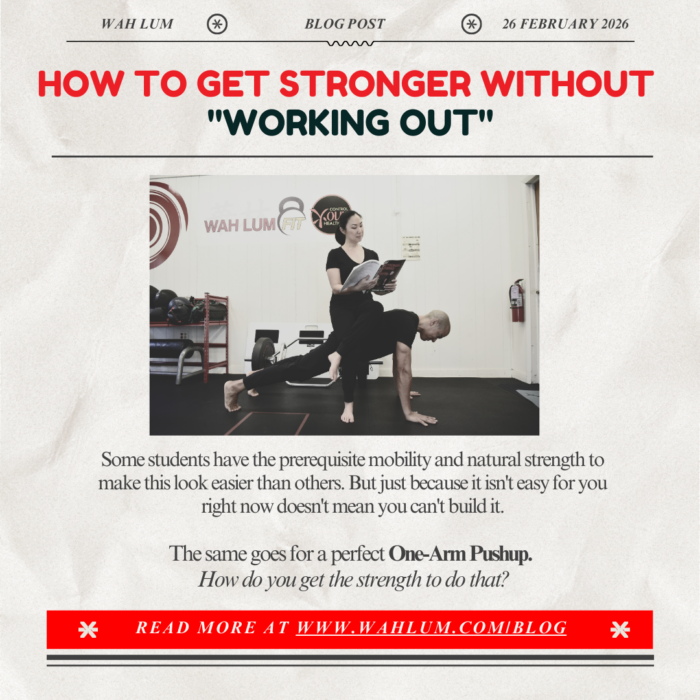
How to get stronger without “working out”
Have you ever looked at a high-level student perform a deep Tam Tui (one-legged squat) and wondered, “How do they have the strength to do that?”
The answer usually isn’t that they spend hours in the gym destroying their muscles.
Yes, some students have the prerequisite mobility and natural strength to make this look easier than others. But just because it isn’t easy for you right now doesn’t mean you can’t build it.
The same goes for a perfect One-Arm Pushup. How do you get the strength to do that?
The answer is to treat strength as a skill, not just a physical attribute.
There is a concept in strength training called “Greasing the Groove” (GTG). It was popularized by Pavel Tsatsouline in his book The Naked Warrior, and it is the perfect methodology for martial artists.
Here is how it works and how you can use it to master your bodyweight mechanics.
The Concept: Strength is a Skill
Imagine you are trying to learn a new song on the piano. Would you practice it once a week for 5 hours until your fingers bled and you were exhausted?
I guess that is an option. But the better option would be to practice it for 10 minutes a day, every day. You would play it perfectly, stop before you got tired, and come back to it later.
Greasing the Groove is the same concept applied to strength.
When you do an exercise, your brain sends a signal through your nervous system to your muscles. The more often you send that signal without fatigue, the more efficient the “groove” becomes.
The Rules of GTG
- Frequency over Intensity: You do the movement throughout the day, but never to failure.
- Stay Fresh: You should feel stronger after the set than when you started. If your max is 5 reps, you only do 1 or 2.
- Perfect Form: Because you are “grooving” a neurological path, every rep must be perfect. If you practice sloppy reps, you are greasing a sloppy groove.
The “Naked Warrior” Combo for Kung Fu
If you want to build full-body tension and power for your forms, try applying GTG to these two movements:
- The Tam Tui (One-Legged Squat/Pistol) In the fitness world, this is called a “Pistol.” In Wah Lum, it’s the strength behind our Tam Tui kicks and deep stances.
- The Progression: If you can’t do a full one yet, don’t force it. Use a box to sit down on, or hold a doorframe for assistance.
- The Groove: Every time you walk through a specific doorway in your house, do one perfect rep on each leg.
- The One-Arm Pushup This teaches total body integration, connecting the hand to the core to the feet.
- The Progression: Start doing them on an incline (like against a kitchen counter or a staircase). As you get stronger, move lower to the floor.
- The Groove: Every time you go into the kitchen, do one perfect rep on each arm.
The Result
By the end of the day, you might have done 10-20 reps of each exercise. By the end of the week, that can be up to 140 reps.
You aren’t sweaty. You aren’t sore. But your nervous system is learning how to fire those muscles with incredible efficiency.
So, pick a move you want to master. Stop trying to “workout” until you drop. Start greasing the groove.
As my strength coach Brett Jones would remind me about GTG, the reps are done fresh, frequently, and flawlessly. You need all three for each rep.
See you in training,
Sifu Oscar
P.S. There are 2 ways I can help you Start the groove.
- See it for yourself: The best way to understand Wah Lum is to see it in person. Email us kungfu@wahlum.com with Observation and we will set up a time for you to come visit a class.
- Guidance: The best way to get strong is to start small and be consistent. If you are looking for a program to help you build the habit of daily movement, Control System: Foundations is the blueprint. Email us kungfu@wahlum.com with FOUNDATIONS and I’ll send you the details.
