Longevity Training: Staying Strong in Kung Fu and Tai Chi After 56

Lately I have been thinking about what my training will look like 10 years from now, when I am over 56. At that stage, my priorities will shift. 

The goal will not be chasing personal records or max lifts. The goal will be staying strong, mobile, and consistent so I can keep practicing Kung Fu and Tai Chi.

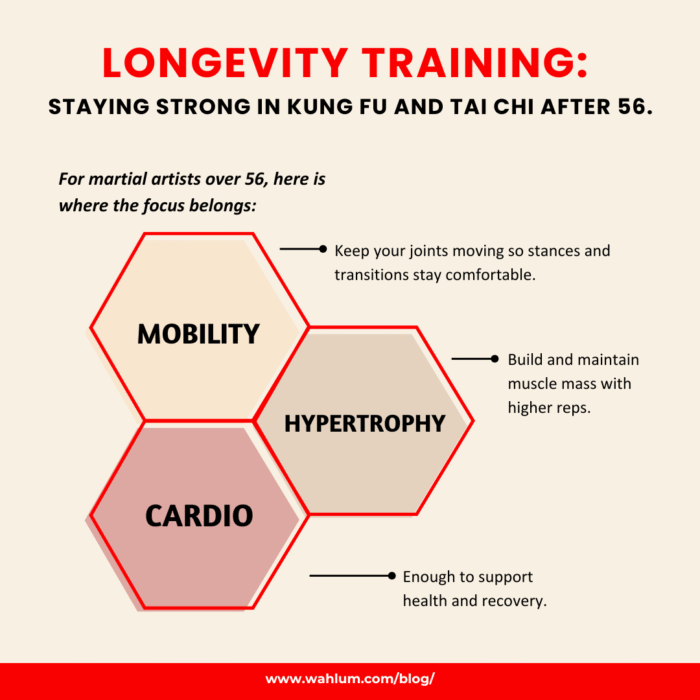
For martial artists over 56, here is where the focus belongs:

  • Mobility: keep your joints moving so stances and transitions stay comfortable.
  • Hypertrophy: build and maintain muscle mass with higher reps. This does not have to mean machines — kettlebells, bodyweight movements, bands, and light dumbbells are all excellent options.
  • Cardio: enough to support health and recovery. This can be as simple as practicing forms at a faster pace with good control, or walking daily.

After 56, it is less about maxing out and more about staying consistent with quality movement. 

Show up, move, breathe, keep the reps high, and release tension between sets. 

In Kung Fu and Tai Chi, that might mean practicing stances, transitions, and balance drills with steady repetition until they feel effortless.

The key is to keep going. Keep training. Keep showing up.

See you in training,

Sifu Oscar


P.S. The principle of stretching what is stiff and strengthening what is weak starts on day one. That is what our Foundations program is all about. Reply with Foundations and I will get you started.


P.P.S. Whenever you’re ready, here are ways we can help you get started.

1. Schedule a time to observe a class.
Interested in Kung Fu or Tai Chi?  First step is to watch a class and see if we would be a good fit! Email: kungfu@wahlum.com for an appointment.

2. Become part of my exclusive Coaching Group with CYH Remote Coaching.  Get personalized coaching delivered right to your phone and catered to your specific goals.
Email: kungfu@wahlum.com for info.

Push, Pull, and the Lessons of Middle Age

In your late teens and 20s, the choices you make with food and training will stay with you. Strength coach Mike Boyle shared the best advice I know when it comes to body composition, and it is especially true in your 20s. 

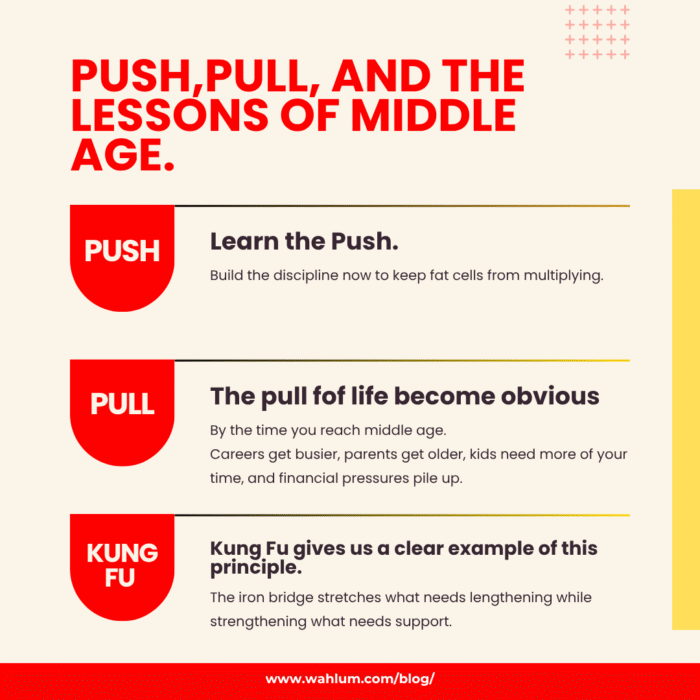
Learn the Push. 

Push the table away. Push the extra beer and pizza away. 

Build the discipline now to keep fat cells from multiplying.

Why? Because once you create fat cells, they don’t just disappear. Fat cells act like balloons. When you overeat, it is like blowing air into the balloon and it expands. 

When you train, eat better, and lose fat, you don’t pop the balloon. You simply let the air out. It shrinks, but it never disappears. 

That is why learning the skill of Push early is so valuable. But even if you did not learn it in your 20s, it is not too late. 

The ability to push away what does not serve you is a practice you can strengthen at any age.

By the time you reach middle age, the Pulls of life become more obvious. 

Careers get busier, parents get older, kids need more of your time, and financial pressures pile up. At the same time, your body starts sending reminders — tighter hips, rounded shoulders, slower recovery. 

Strength coach Dan John sums up the solution perfectly: Stretch what’s stiff. Strengthen what’s weak. For most of us, that means:

  • Stretch: hip flexors, hamstrings, pecs, biceps
  • Strengthen: glutes, ab wall, deltoids, triceps

Over six years ago, Sifu Mimi and I started a video blog series called 40 Fit-Fu. We recorded more than 100 episodes on training, nutrition, and health. 

If you scroll to the bottom of the playlist, you will find our final episodes where we looked back at the first ones and shared how our approach has evolved. 

Training is a lifelong process. What works at 20 might not be what you need at 40, and what you build at 40 sets you up for your 60s.

Kung Fu gives us a clear example of this principle. 

The iron bridge stretches what needs lengthening while strengthening what needs support. 

It is also a classic Push-Pull exercise: pushing the hips up, pulling the shoulders back. That combination is exactly what keeps us strong, mobile, and balanced through every stage of life.

See you in training,

Sifu Oscar


P.S. The principle of stretching what is stiff and strengthening what is weak starts on day one. That is what our Foundations program is all about. This is also remote coaching through our app, with daily actions and accountability built in. Reply with Foundations and I will get you started.


P.P.S. Whenever you’re ready, here are ways we can help you get started.

1. Schedule a time to observe a class.
Interested in Kung Fu or Tai Chi?  First step is to watch a class and see if we would be a good fit! Email: kungfu@wahlum.com for an appointment.

2. Become part of my exclusive Coaching Group with CYH Remote Coaching.  Get personalized coaching delivered right to your phone and catered to your specific goals.
Email: kungfu@wahlum.com for info.

Finding Your “Why” in Training

What makes you Tick?

I’ve been thinking a lot about how to make real progress in training. This applies to any pursuit, but for me, it’s mostly Kung Fu, Tai Chi, and strength training.

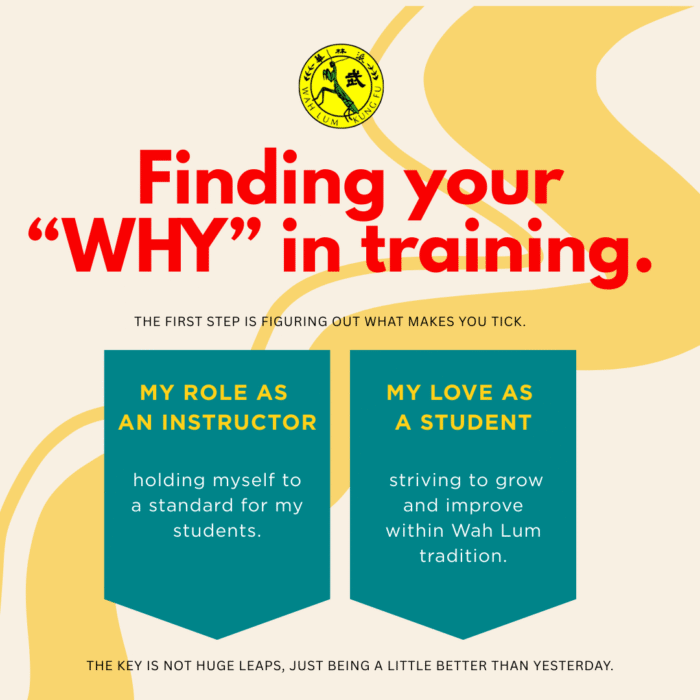
The first step is figuring out what makes you tick. What keeps you putting in effort consistently; through the tough days, weeks, and years? What’s your why?

For me, it’s two things:

  • My role as an instructor, holding myself to a standard for my students. 
  • My love as a student, striving to grow and improve within Wah Lum tradition. 

Another tool that’s helped me, especially in strength training, is writing things down. Sets, reps, weights, and notes on how I felt. Keeping track makes it clear that even when I feel stuck, I am progressing.

I don’t do this enough in Kung Fu and Tai Chi. Sure, I can see I’ve learned more forms and techniques, but quantity doesn’t equal quality. I could track martial intent, smoothness, endurance; maybe even score myself 1–10.

My plan? Before each training session, open my journal, review the last session, and decide one small way I’ll beat my past self. The key is not huge leaps, just being a little better than yesterday.


See you in class,

Sifu Oscar


P.S. Whenever you’re ready, here are ways we can help you get started.

1. Schedule a time to observe a class.
Interested in Kung Fu or Tai Chi?  First step is to watch a class and see if we would be a good fit! Email: kungfu@wahlum.com for an appointment.

2. Become part of my exclusive Coaching Group with CYH Remote Coaching.  Get personalized coaching delivered right to your phone and catered to your specific goals.
Email: kungfu@wahlum.com for info.

Kung Fu, Tai Chi, Steps, and the Other 165 Hours of Your Week

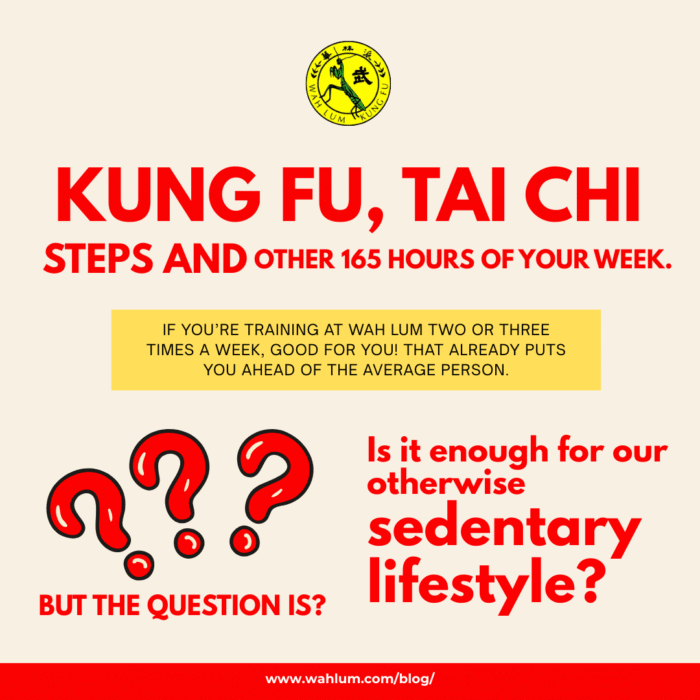
If you’re training at Wah Lum two or three times a week, good for you! That already puts you ahead of the average person. But here’s a question: is it enough for our otherwise sedentary lifestyle?

There are 168 hours in a week. Even with three intense classes, that still leaves 165 hours to fill. What are you doing with the rest of your time?

A few months ago, I read strength coach Dan John’s experience with walking 10,000 steps a day. He credited that simple habit (not an extreme workout plan) with helping him get lean and stay lean. Inspired, I bought a $15 pedometer for a 30-day experiment. I chose an inexpensive one for two reasons:

  • Studies suggest basic pedometers can be more accurate than fancy phones. 
  • I didn’t want to rely on my phone or invest in a high-tech watch for a short trial. 

It turns out that walking 10,000 steps is not a new concept. The idea gained popularity in Japan during the lead-up to the 1964 Tokyo Olympics, when a pedometer brand called manpo-kei (literally “10,000 steps meter”) used the number as a catchy marketing tool. While the number wasn’t based on science at the time, modern research shows it’s a pretty good daily target for overall health.

Here’s what I learned from my own trial:

  • Hitting 10,000 steps was harder than I thought unless I planned for it. 
  • Kung Fu and strength training alone didn’t get me there, even if I did both on the same day. 
  • Yard work easily pushed me past the goal, as did a 45–60 minute walk with my mom on Sundays. 
  • On most other days, I had to intentionally add movement to hit the target. 

One interesting side effect: when I hit 10,000 steps or more, I felt pleasantly tired and wanted to go to bed earlier. That alone felt like a win.

I also realized I didn’t need to wear the pedometer all day. Instead, I put it on only when I was going to move outside of Kung Fu or strength training, such as during walks or yard work. This way, my steps were “true” additional movement, not just my daily total. Even hitting 5,000–8,000 intentional steps this way felt beneficial.

Walking might not sound as exciting as throwing kicks or moving weights around, but it’s a simple, proven way to add more movement to your life. So, the next time you think about your training, remember: it’s not just about the three hours a week you spend at the Temple, it’s about the other 165 hours too.

-Sifu Oscar

Why Training Barefoot (or Close to It) Matters

Hey there,

A long time ago, people walked and even ran without shoes—up hills, down rocky canyons, and across the grasslands, all barefoot. Then came sandals, running shoes, and, at some point, even Kinky Boots.

(I saw the musical and enjoyed it, but I digress.)

Just like everything else these days, we have endless options for our feet. This post isn’t about fashion, but I’ve been told that the incredible discomfort of wearing a certain shoe with a red bottom is totally worth it.

But when it comes to movement—whether in Kung Fu, Tai Chi, or strength training—your feet need more than just style.

Why Try Going Barefoot?

Your body is a superstructure, and your feet are its built-in foundation. They’re designed to be strong, mobile, and capable. When we put them in stiff, cushioned shoes, it’s like taking color out of our vision—life (and movement) becomes a little less vibrant.

Two key reasons I go barefoot or wear minimalist (my Wah Lum) shoes when training:

  1. Better Proprioception

Proprioception is your brain’s ability to sense where your body is in space. The more feedback your feet receive from the ground, the better your body moves. Shoes that squish your toes reduce this feedback, leading to weaker stabilizers and poor coordination.

That said, the shoes we use for Kung Fu and Tai Chi do bring the toes closer together than ideal, but after over 20 years of training at Wah Lum, I feel it’s well worth it. When making dynamic movements or quick directional changes, I’ve found that a thin sole and a snug fit provide security in my stances.

Plus, since I only wear them for an hour at a time, my feet still get plenty of time to splay and move naturally.

At Wah Lum, we also place great importance on looking uniform in class. Yes, each student is unique and special, but what truly makes us unique is that we’re all training together, in the same uniform, practicing the same martial art. 

That shared discipline and tradition set us apart.

  1. Improved Strength and Mobility

If you don’t need to protect your feet from the cold or sharp objects, try going barefoot. Start by walking around the house when you get home and maybe even introducing toe separators for short periods. As you get stronger, you’ll be able to go for longer periods of time.

Barefoot walking also helps improve big toe dorsiflexion (flexing the big toe upward), which impacts movement throughout the body. Most shoes don’t allow for this unless they have a wide toe box and zero drop (no heel elevation).

Shoes and Training

Stiff, thick-soled, highly cushioned shoes limit foot mobility and proprioceptive input, essentially putting your feet in casts. They disconnect you from the ground, which is the opposite of what you want when strength training.

In martial arts, this connection—often called “rooting”—is fundamental. It’s just as important for lifting.

The Problem with Raised Heels

Most athletic shoes have built-in heels that shift your center of gravity forward. This:

  • Deactivates the backside of the body (posterior chain)
  • Overloads the quads
  • Reduces core activation
  • Increases stress on the lower back

All of this forces improper body mechanics and increases injury risk. Proper mechanics not only help generate more force (hello, strength gains!) but also protect your joints and connective tissues.

The Best Shoe for Strength and Martial Arts Training

If you’ve been wearing thick, cushioned shoes for years, don’t jump straight into barefoot training. Instead:

  1. Transition to shoes with a slightly lower heel.
  2. Gradually move to a thin, flexible sole that bends at the arch.
  3. Consider your range of motion, joint strength, and stability before going fully barefoot.

Think about it this way: Would you load heavy weight onto a weak and unstable shoulder? Probably not. The same logic applies to your feet.

If you are a Wah Lum Student you are in luck! The shoes provided for training are designed to support your Kung Fu and Tai Chi practice. Over time, you’ll get used to them and notice how they enhance your movement, balance, and connection to the ground.

Bonus: A Fun Foot-Strengthening Trick

Want to improve your foot strength and mobility? Try standing on a box of rocks. Yep, just like it sounds. And while you’re at it, enjoy a single malt scotch on the rocks—because balance is key in more ways than one!

One Last Thought: Running vs. Strength Training

This post focuses on martial arts and strength training, not running—which is a skill that deserves its own discussion. But whatever you do, make sure your shoe is lightweight. Every extra 500 grams on your foot equals an extra 10 pounds on your back.

Your challenge: Spend a little time barefoot every day. Feel the ground, spread your toes, and see how it changes your movement.

Stay grounded,

Sifu Oscar

You Get To Choose

I want you to try a short experiment. Look straight ahead, then look up, and then look straight again. 

Did you notice yourself inhaling when you looked up? If not, try it again and pay attention to your breathing. 

Breathing is often taken for granted, but it can have a profound impact on our practice. A small adjustment in our breathing can yield significant results. 

Kung Fu and Tai Chi, with their generations-old wisdom, have never disconnected movement from breathing. The ancient practitioners realized that the breath could affect the nervous system, heightening, relaxing, or balancing it. 

Breathing is unique in that it’s the only physiological function we can control both consciously and unconsciously. It bridges the gap between our voluntary and involuntary processes. 

While breathing is automatic, we have the ability (if we choose) to control its speed and depth voluntarily. 

At Wah Lum, we emphasize breathing first, allowing movement to unfold naturally. We then sync our movement with our breath, creating a harmonious mind-body connection. 

Breathing is the foundation of our practice, whether it’s Kung Fu, Tai Chi, or strength training. 

It cannot be overemphasized. 

From beginning to the end of every movement system, breath is the essence. 

Stay mindful of your breathing and let it guide your practice. 

Sifu Oscar


P.S. Whenever you’re ready, here are ways we can help you get started.

1. Schedule a time to observe a class.
Interested in Kung Fu or Tai Chi?  First step is to watch a class and see if we would be a good fit! Email: kungfu@wahlum.com for an appointment.

2. Become part of my exclusive Coaching Group with CYH Remote Coaching.  Get personalized coaching delivered right to your phone and catered to your specific goals. Email: kungfu@wahlum.com for info.