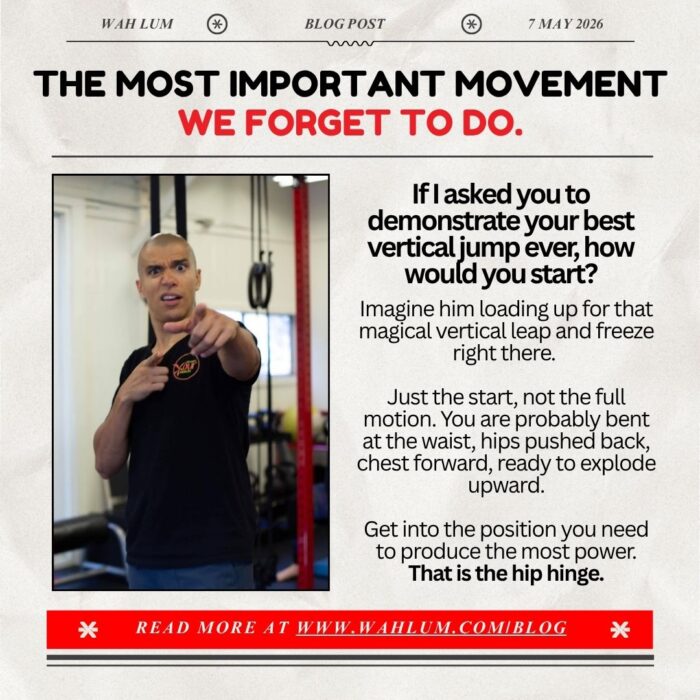
The most important movement we forget to do
If I asked you to demonstrate your best vertical jump ever, how would you start?
Go ahead and channel your inner Michael Jordan. Imagine him loading up for that magical vertical leap and freeze right there.
Just the start, not the full motion. You are probably bent at the waist, hips pushed back, chest forward, ready to explode upward.
Get into the position you need to produce the most power. That is the hip hinge.
And it is one of the most important movements you can practice.
To understand why, we have to go back in time. As newborns, we come into the world infinitely mobile, but we have to earn our stability starting from the center.
We learn to breathe diaphragmatically, gain head control, build strength in our arms and legs, roll over, and eventually make our way to standing.
After thousands of repetitions in each of these stages, we start walking, running, and jumping. The newborn had to stabilize to express mobility.
Essentially, from birth, you are working your way toward an explosive hip hinge.
Having four sons (only one year apart) and the last two being twins, my poor mother watched these stages with delight in the beginning, and then in fear and anxiety.
True story: there was a year where we had an average of one ER visit a month. Back in the 80s, we had to go outside and “play.”
My brothers, being way more athletic, got into scrapes from athletic moves. Being clumsy from reading too much, I got scraped up by not being able to produce or reduce power!
Some people think of the hinge just as a gym deadlift, picking something “dead” off the ground from a dead stop.
But the hip hinge done slowly and explosively is used in almost every sport, everyday life, and even at Wah Lum® Kung Fu and Tai Chi.
- In Kung Fu: When we drop our weight in our horse stance to generate an explosive strike as we move into the hill-climbing horse stance, we are hinging.
- In Tai Chi: When you sink your weight (folding at the hip crease) to absorb an opponent’s push and redirect it into a Bow Stance, you are using the exact same mechanics.
Losing Power = Getting Slower
As we age, we get slower at a much faster rate than we get weaker. This translates to older adults slipping and falling simply because they haven’t moved quickly in years.
Being able to get into and out of a hip hinge quickly shows that you can produce power (jump) and reduce power (land safely).
You can train for power to prevent a fall or to keep up with your children, or train to throw a more effective punch.
How to Test and Train Your Hinge
We all need to hip hinge in the same way that we all need to squat. You’ve done it before; your body just needs to be reminded how.
- The Toe Touch Test: Can you touch your toes? This requires a certain amount of mobility, but it also has a lot to do with your ability to weight shift. Here is a video that can help.
- Toe Touch To Pull Down Squat: If you can touch your toes, grab them and pull your hips down into a deep squat. Now stand back up. You’ve just shown me a mobile pelvis and a stable trunk. You are ready to hinge. Watch the video here.
- Training Wheels: Use a light stick held against your back to practice pushing your hips backward while keeping proper form and a straight spine. Watch the video here.
- Load it Up: The next step is to load the hinge. I like the Kettlebell Deadlift. Watch the video here.
- Build Explosive Power: Finally, progress to a great power movement: the Kettlebell Swing. It is a dynamic deadlift that uses hip-hinging, power acceleration, and power deceleration (think: lifting, jumping, landing). Watch the video here.
From the KB Swing, you can progress to many different explosive movements depending on your goals.
What an elite athlete considers power training might be impossible for the average client. And what an older client considers power training might be a warm-up for the athlete. It’s all relative.
Either way, train for power. Know your capabilities and go practice the hip hinge.
You’ll still be standing while others are falling.
See you in training,
Sifu Oscar
P.S. Build power safely. People often avoid martial arts because they think they aren’t explosive or mobile enough to start. The truth is, we rebuild those abilities from the ground up. If you are ready to start moving better, here are 2 ways I can help:
- See it for yourself: The best way to understand Wah Lum® is to see it in person. Comment with OBSERVATION and we will set up a time for you to come visit a class.
- Start from home: Comment with FOUNDATIONS and I’ll send you the details for our 21-day remote prep program.

