Finding the balance between “Me” and “We”
When you walk through the doors of the Wah Lum® Temple, you aren’t just joining a gym or signing up for a class. You are stepping into a lineage. You are becoming part of a martial arts family.
But navigating what a “martial arts family” actually means in the modern world is one of the most challenging balancing acts we face.
It requires balancing two very different cultural mindsets, and honestly, it’s a harmony we are constantly working to refine.
Most of us were raised in a Western culture that deeply values individualism. We are taught to prioritize uniqueness, personal freedom, and looking out for number one. It’s a mindset of: “What is best for me?”
Traditional Kung Fu and Tai Chi, however, are rooted in Eastern culture. There, the priority shifts from the individual to the collective. The mindset is: “What is best for the community?”
In a traditional school, the group moves together, sweeps the floor together, and respects the rules of the house. The policies aren’t there to restrict your uniqueness; they are there to protect the safety, discipline, and energy of the entire school.
When someone comes in without any context and a purely Western individualistic mindset, a strict school policy can feel rigid or cold. But once you realize that your actions affect others, honoring the rules becomes not just a way to show respect for the family, but a way to demonstrate true discipline in your art.
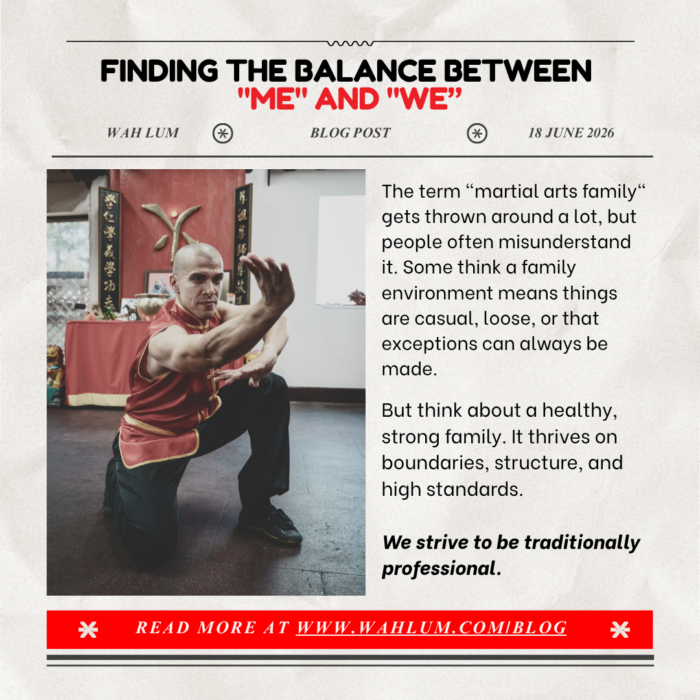
The term “martial arts family” gets thrown around a lot, but people often misunderstand it. Some think a family environment means things are casual, loose, or that exceptions can always be made.
But think about a healthy, strong family. It thrives on boundaries, structure, and high standards.
We strive to be traditionally professional.
- We are a traditional school dedicated to preserving a deep lineage.
- We are a welcoming martial arts family that cares for its members.
- And at the same time, we are a professional business that must maintain strict, clear policies to keep our doors open and our standards high.
Being strict with our policies—whether it’s about attendance, uniform standards, safety, or tuition—isn’t done to be difficult. It’s done because a school without structure ceases to be a traditional lineage. It just becomes a playground.
Finding the exact sweet spot between a traditional family and a professional business is tough. If we are too rigid, we lose the warmth. If we are too loose, we lose the standard.
We don’t always get it perfect, but it is a balance we will continue to work on.
When we ask you to bow, to wear the uniform properly, or to respect the guidelines of the training floor, we are asking you to step out of the “me” for a couple of hours and step into the “we.”
Thank you for being part of our family, for respecting the lineage, and for helping us maintain a standard of excellence both inside and outside the Temple walls.
See you in training,
Sifu Oscar
P.S. Curious about Wah Lum®? People often hesitate about joining a traditional martial arts school because they think it’s exclusive or intimidating. They worry they won’t fit in or they’re not “martial arts enough” to start. If that sounds like you, here’s the truth: we’re selective about who joins because we care about building a real community—not because we’re looking for people who already know everything. If you’re ready to see what that looks like, here are 2 ways I can help:
- See it for yourself: The best way to understand Wah Lum® is to step through the doors in person. Comment with OBSERVATION and we’ll set up a time for you to watch a class.
- Start from home: Comment with FOUNDATIONS and I’ll send you the details for our 21-day remote prep program.