Do you need to add, or do you need to shed?

Hello, Wah Lum Family!

The author James Clear shared a thought that struck a chord with how we approach our training:

“There are two ways to grow: by adding or by shedding. Do you need to add something or do you need to shed something?”

Our default setting is usually to add. We want to learn a new form, pick up a new weapon, lift heavier weights, or train more days a week.

But often, the biggest leap in our progress comes when we choose to shed. And usually, what we need to shed is the expectation that we must excel at everything all the time.

You cannot be at your best every day

We put an immense amount of pressure on ourselves to perform perfectly every time we step onto the training floor. But as my strength coach Brett Jones has reminded me many times:

“Only the mediocre are at their best all of the time.”

If you are always at your “best,” it means you are staying entirely within your comfort zone. You aren’t pushing the boundaries of your mobility, your strength, or your mind. Real growth is messy. It means having days where your stances feel weak, your mind is foggy, and you feel like you are taking two steps back.

Implementation over Ideas

When we accept that we won’t be perfect every day, we realize a fundamental truth about Kung Fu and life: What prevails is rarely the best idea, but the best implementation.

You don’t need a secret, magical training protocol. You just need to show up and do the work, even when you aren’t at your best.

It is only now, after 25+ years in Wah Lum, that I can truly appreciate this. As I reflect on my own limitations and what I might humbly call my own “mediocrity” compared to the ideal, I am more in awe of Grandmaster Chan than ever. His great skill didn’t come from being perfect every single day; it came from relentless, decades-long implementation.

The power of the “Amateur”

So, if we aren’t going to be perfect, and if we are constantly humbled by the art, why do we keep doing it?

There is a great quote from the show Mozart in the Jungle that captures the mindset we need to cultivate:

“You say ‘amateur’ as if it was a dirty word. ‘Amateur’ comes from the Latin word ‘amare’, which means to love. To do things for the love of it.”

Shed the need to be perfect. Shed the frustration of not being at your best today.

Embrace being an amateur. Step onto the floor, put in the reps, and train simply for the love of the art.

See you in training,

Sifu Oscar


P.S. Whenever you’re ready, here are ways we can help you get started.

1. Schedule a time to observe a class.
Interested in Kung Fu or Tai Chi?  First step is to watch a class and see if we would be a good fit! Email: kungfu@wahlum.com for an appointment.

2. Become part of my exclusive Coaching Group with CYH Remote Coaching.  Get personalized coaching delivered right to your phone and catered to your specific goals.
Email: kungfu@wahlum.com for info.
Stop Competing With Your Ideal

I’ve been thinking a lot about the words we use, and how they shape our Kung Fu and Tai Chi training. There are two words that are often mixed up, and confusing them can mess with your progress:

Ideal and Optimal.

The Trap of the “Ideal”

The Ideal has to do with comparison.

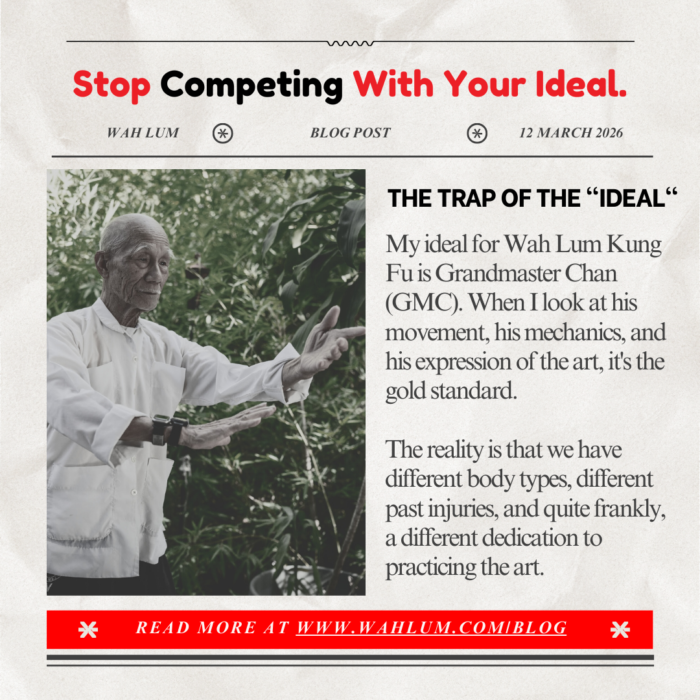
My ideal for Wah Lum Kung Fu is Grandmaster Chan (GMC). When I look at his movement, his mechanics, and his expression of the art, it’s the gold standard.

The reality is that we have different body types, different past injuries, and quite frankly, a different dedication to practicing the art.

For example, Sifu Tu is another ideal for me. When standing, we are different heights, but when sitting, we are the same height. Sifu Tu started at around 10 with full splits and a lot of focused training; I started in my 20s with shoulder injuries, overall stiffness, and exercise ADD (always having different training goals).

I can and do use GMC, Sifu Tu, or Sifu Mimi as ideals to motivate me and give me a North Star to aim for. 

But I will not compete with my ideal. 

Treating the ideal as the standard, I have to perfectly match every day, which places me in an external competition that I cannot win. I would constantly feel like I am falling short, which ultimately leads to deep disappointment and burnout.

The Power of the “Optimal”

Your optimal self is not a fantasy version of you. It isn’t even the best you hope to be five years from now.

Your Optimal is the best you can do today. Right now.

It’s the best you can do with the body you bring to the training floor today. With your current physical reality. With the stress you are carrying from work. With the sleep you got last night.

  • The Ideal is external comparison.
  • The Optimal is internal competition.

When you stop comparing yourself to the Ideal and start competing with yourself to find today’s Optimal, that is when true, sustainable improvement happens.

Preparing for the Unknown

This shift in mindset changes how we train.

We don’t train just to plan for one specific, “ideal” scenario, because in training, as in life, the ideal scenario rarely happens.

Instead, we prepare by building an optimal mindset. A mindset that doesn’t shatter when things aren’t perfect. A mindset that can handle uncertainty and still execute the best possible response with whatever tools are available in that exact moment.

Let the Ideal inspire you. Let the Optimal drive you.

See you in training,

Sifu Oscar


P.S. Stop waiting for the “ideal” time. People delay starting martial arts because they are waiting for the ideal time—when work slows down, when they lose 10 pounds, when life is less stressful. The ideal time is a myth. The optimal time is today, with your life exactly as it is. Here are 2 ways I can help:

  1. See it for yourself: The best way to understand Wah Lum is to see it in person. Comment with OBSERVATION, and we will set up a time for you to come visit a class.
  2. Start from home: Comment with IDEAL and I’ll send you the details for our 21-day Foundations program.

The Power of the Gap

Magician Asi Wind once shared how much it bothers him to see an audience on their phones right up until the moment his show begins. 

He wants to reset their minds, to give them a clean palate before the performance starts. 

Without that pause, people jump straight from screen stimulation into the show without a gap in between.

Neuroscientists explain why this matters. Our brains need those gaps. 

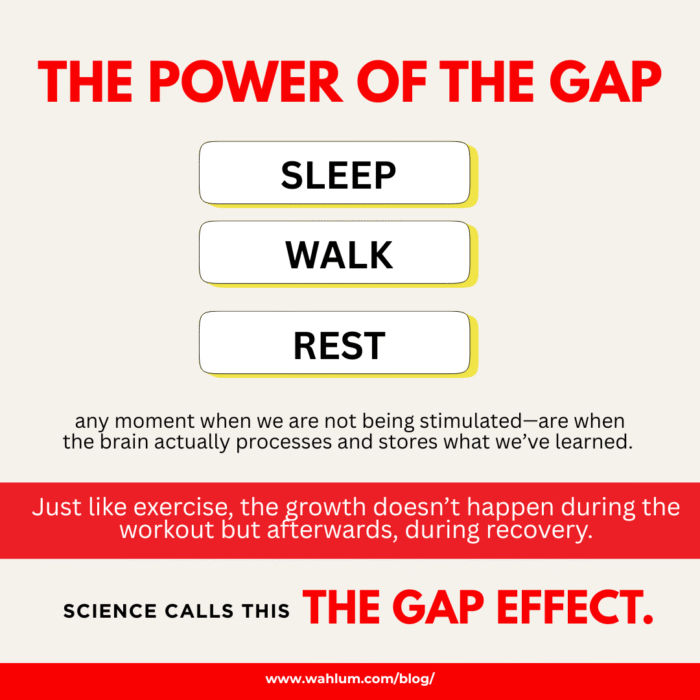
Sleep, walks, rest—any moment when we are not being stimulated—are when the brain actually processes and stores what we’ve learned. 

Just like exercise, the growth doesn’t happen during the workout but afterwards, during recovery.

Science calls this the gap effect. When we stop practicing for a moment, the brain continues rehearsing in the background, replaying what we just learned at incredible speed and even in reverse. 

These quiet spaces allow information to be encoded more deeply than nonstop practice ever could.

This is true in music, math, magic, Kung Fu, and Tai Chi. Constant repetition matters, but spacing it with intentional pauses may be even more powerful. 

In our training, those brief moments of stillness between sets, between forms, or during meditation are not wasted time. They are when the body and mind begin to weave together the lesson.

Mastery doesn’t just come from the work. It also comes from the gaps.

See you in training,

Sifu Oscar


P.S. Whenever you’re ready, here are ways we can help you get started.

1. Schedule a time to observe a class.
Interested in Kung Fu or Tai Chi?  First step is to watch a class and see if we would be a good fit! Email: kungfu@wahlum.com for an appointment.

2. Become part of my exclusive Coaching Group with CYH Remote Coaching.  Get personalized coaching delivered right to your phone and catered to your specific goals.
Email: kungfu@wahlum.com for info.
Managing Force, Not Absorbing It

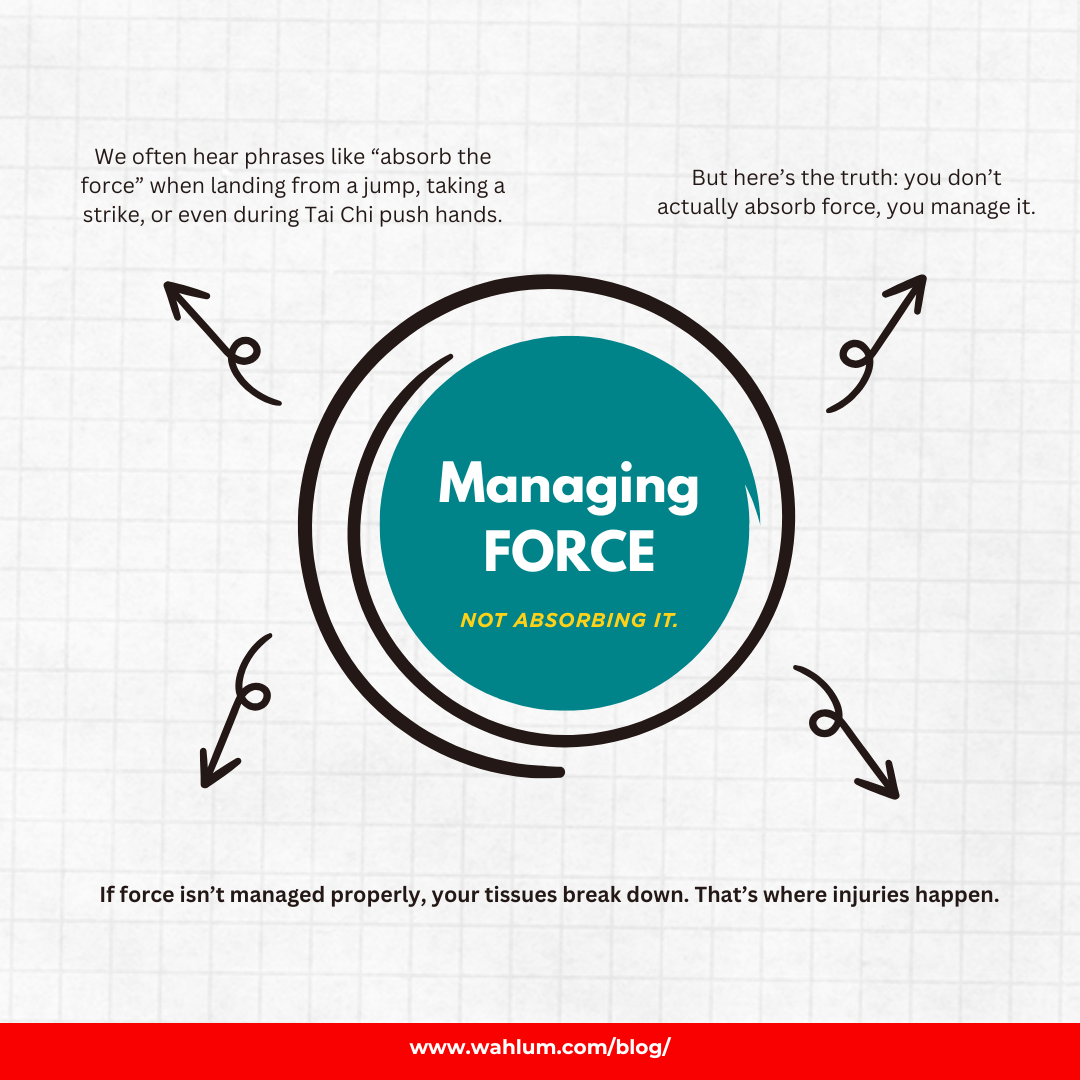
We often hear phrases like “absorb the force” when landing from a jump, taking a strike, or even during Tai Chi push hands. But here’s the truth: you don’t actually absorb force, you manage it.

If force isn’t managed properly, your tissues break down. That’s where injuries happen.

Newton’s 3rd Law reminds us: for every action, there is an equal and opposite reaction. When your foot hits the ground, the ground pushes back with equal force. This is called ground reaction force—and it’s something we must learn to control.

In Kung Fu, especially when we practice jumps, our ability to manage these forces makes all the difference. Here’s what the body deals with every time we move:

  • Walking: 1–1.5 × your bodyweight
  • Running: 2–2.9 × your bodyweight
  • Jumping: up to 7 × your bodyweight

Think about that. A 150-pound person landing from a jump could be managing over 1,000 pounds of force!

In Tai Chi, we practice the same principle in a softer way through push hands. Instead of letting force overwhelm us, we redirect, root, and return it. The skill is not in stopping force, but in managing where it goes.

Whether you’re landing from a Kung Fu jump or feeling pressure in Tai Chi push hands, the lesson is the same: force must be managed. 

Strong stances, mindful practice, and controlled movements keep our bodies safe and our training sustainable.

This week in class, pay attention to how you land, how you root, and how you redirect energy. 

That’s where control and resilience are developed

See you in training,

Sifu Oscar


P.S. Whenever you’re ready, here are ways we can help you get started.

1. Schedule a time to observe a class.
Interested in Kung Fu or Tai Chi?  First step is to watch a class and see if we would be a good fit! Email: kungfu@wahlum.com for an appointment.

2. Become part of my exclusive Coaching Group with CYH Remote Coaching.  Get personalized coaching delivered right to your phone and catered to your specific goals.
Email: kungfu@wahlum.com for info.