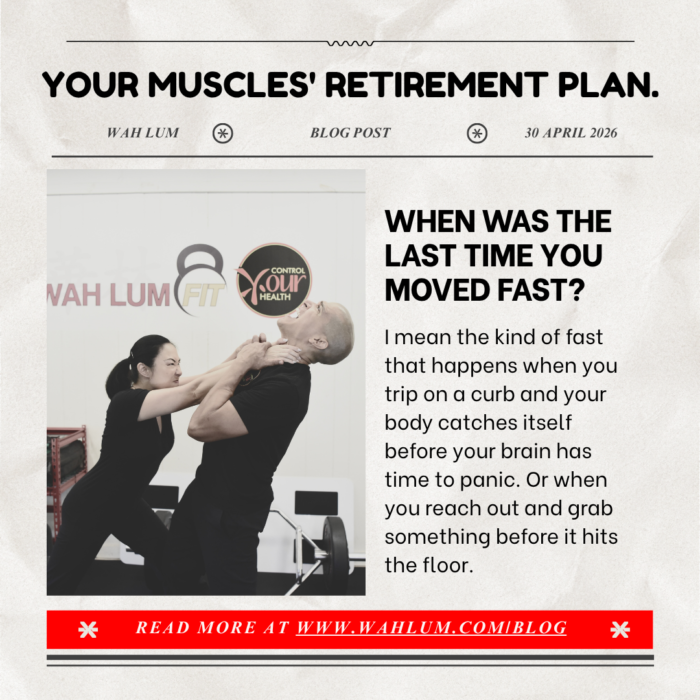
Your muscles’ retirement plan

When was the last time you moved fast?

I mean the kind of fast that happens when you trip on a curb and your body catches itself before your brain has time to panic. Or when you reach out and grab something before it hits the floor.

If it’s taking you a while to think about it, that’s already a bit of information. According to a study published in Mayo Clinic Proceedings, your ability to move quickly might be the most important physical quality determining how long you live.

And most people are losing it without even realizing it.

Researchers followed 3,889 adults aged 46–75 for nearly 11 years. They measured two things: muscle strength (how much force you can produce) and muscle power (how fast you can produce it). Then they watched to see which one predicted survival.

The answer wasn’t subtle.

Men with the lowest power levels were almost 6 times more likely to die than those with the highest. Women in the lowest group faced nearly 7 times the risk. And muscle strength, measured on its own? Not statistically significant.

Power won the longevity contest by a landslide — and it wasn’t even close.

Your body runs two types of muscle fibers. Type I fibers are your slow-burn workhorses — built for endurance, posture, and the long haul (think holding a deep Horse Stance or doing a slow Tai Chi form). Type II fibers are your explosives — fast, powerful, and built for moments that require immediate action (think jumping, throwing a fast punch, or a snapping kick).

Type II fibers are also the first ones to disappear, and we lose power at a faster rate than we lose strength. Age and inactivity, accelerate their decline. You can maintain a respectable amount of strength for years while your fast-twitch system quietly goes away.

Until a stumble that should have been a quick save becomes something much worse.

The researchers called this loss of power “powerpenia” — a word that sounds made-up but represents a very real, measurable decline that most standard fitness programs simply don’t address.

The good news? Power is trainable at any age. And you don’t have to become an Olympic athlete to develop it. You just have to ask your muscles to move quickly — on purpose, consistently, and with intention.

This is exactly why the right type of training is so vital. We don’t just lift heavy things slowly. We want to train our bodies to be explosive. 

Here is how you can ensure you are keeping those Type II fibers alive, whether you are training Kung Fu or Tai Chi.

  • Strike with intent (Kung Fu): When you practice your forms, don’t just go through the motions. Find time to move with sudden, explosive speed.
  • Intent (Tai Chi): Tai Chi is famous for slow movement, but advanced practice requires Fajin—the sudden, explosive release of power. Even if you aren’t jumping, a quick, intentional shift in weight, a fast block, or the rapid kick in Part 3 trains your nervous system to fire instantly.
  • Lower weights, higher speed: Power doesn’t require lifting 300 pounds. Moving your own body weight or light resistance bands at speed is surprisingly effective and keeps your nervous system sharp.
  • Aim for consistency over intensity: Even one power-focused session per week creates meaningful adaptation over time.

The goal isn’t to be the most explosive person in the room. The goal is to maintain the biological quality that determines whether your body can respond when life gets unpredictable — because it will.

Strength is the foundation. But power is the thing that shows up when you actually need your body to work. The research is now telling us — with nearly 4,000 people and a decade of data — that the ability to move fast is the fitness quality most closely tied to survival.

Train your muscles to move. Train them to fire. And do it before your fast-twitch fibers get the memo that they’re no longer needed.

See you in training,

Sifu Oscar

P.S. Make movement a value. People often fail to start training because they think they need a complicated system to begin. You don’t. You just need to show up. If you are ready to build a new habit, here are 2 ways I can help:

  1. See it for yourself: The best way to understand Wah Lum is to see it in person. Reply with OBSERVATION and we will set up a time for you to come visit a class.

Start from home: Reply with FOUNDATIONS and I’ll send you the details for our 21-day remote prep program.
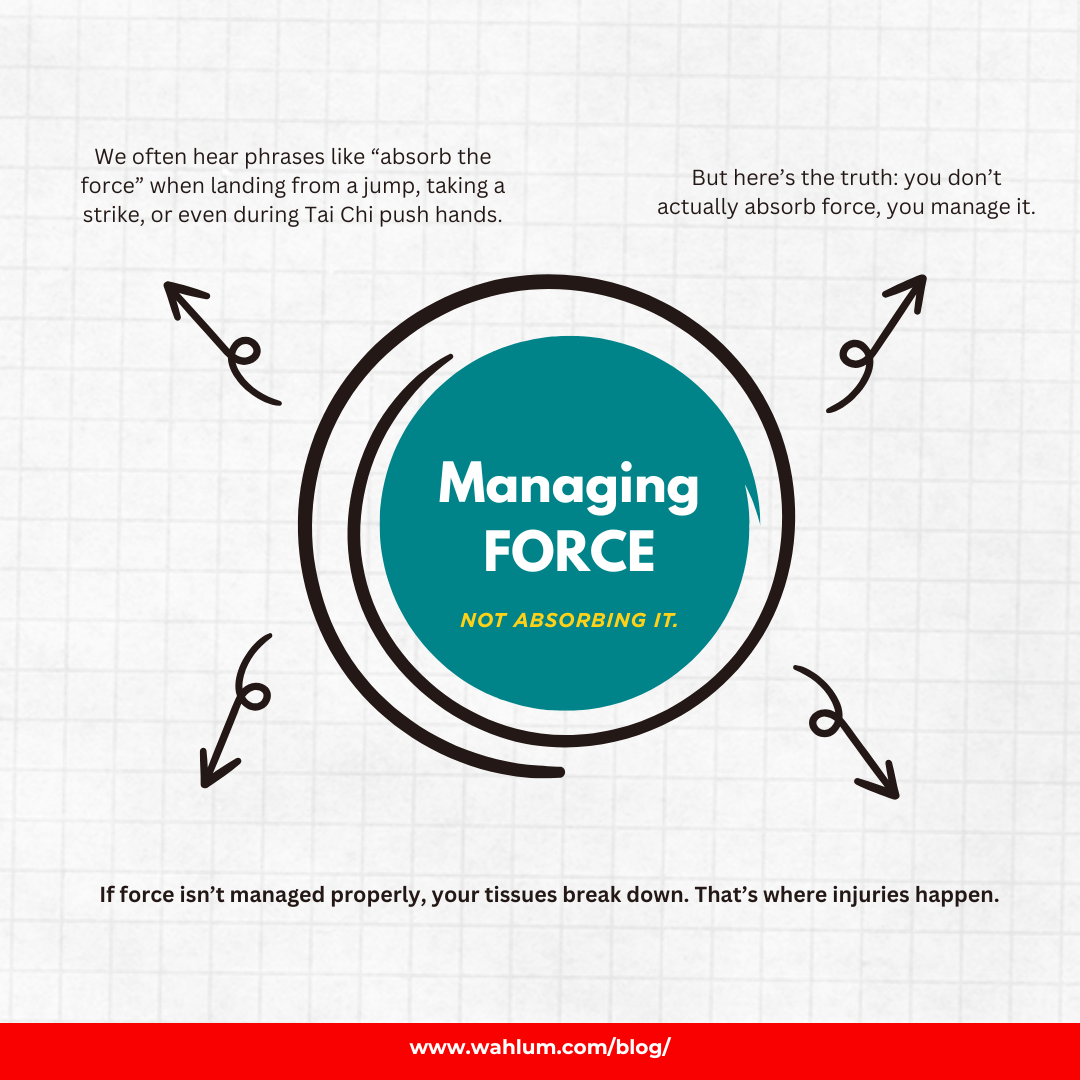
Managing Force, Not Absorbing It

We often hear phrases like “absorb the force” when landing from a jump, taking a strike, or even during Tai Chi push hands. But here’s the truth: you don’t actually absorb force, you manage it.

If force isn’t managed properly, your tissues break down. That’s where injuries happen.

Newton’s 3rd Law reminds us: for every action, there is an equal and opposite reaction. When your foot hits the ground, the ground pushes back with equal force. This is called ground reaction force—and it’s something we must learn to control.

In Kung Fu, especially when we practice jumps, our ability to manage these forces makes all the difference. Here’s what the body deals with every time we move:

  • Walking: 1–1.5 × your bodyweight
  • Running: 2–2.9 × your bodyweight
  • Jumping: up to 7 × your bodyweight

Think about that. A 150-pound person landing from a jump could be managing over 1,000 pounds of force!

In Tai Chi, we practice the same principle in a softer way through push hands. Instead of letting force overwhelm us, we redirect, root, and return it. The skill is not in stopping force, but in managing where it goes.

Whether you’re landing from a Kung Fu jump or feeling pressure in Tai Chi push hands, the lesson is the same: force must be managed. 

Strong stances, mindful practice, and controlled movements keep our bodies safe and our training sustainable.

This week in class, pay attention to how you land, how you root, and how you redirect energy. 

That’s where control and resilience are developed

See you in training,

Sifu Oscar


P.S. Whenever you’re ready, here are ways we can help you get started.

1. Schedule a time to observe a class.
Interested in Kung Fu or Tai Chi?  First step is to watch a class and see if we would be a good fit! Email: kungfu@wahlum.com for an appointment.

2. Become part of my exclusive Coaching Group with CYH Remote Coaching.  Get personalized coaching delivered right to your phone and catered to your specific goals.
Email: kungfu@wahlum.com for info.

Control Corner 10 from Sifu Oscar: Building Mobility Now, Not Later

Control starts with focus. Welcome to the Control Corner, where we explore Wah Lum’s philosophy of control, represented by the flipped ‘Fire’ character, and apply it to health, martial arts, and life. Let’s ignite your potential together.

Essentials: The best time to build joint and body health isn’t “someday” or “next year”—it’s now. When you incorporate regular mobility exercises, your body builds the strength it needs for smoother, injury-resistant movement. Think of it as your body’s holiday preparation!

Why It Matters: During the year, extra stress and inactivity can affect your joints, leaving you stiff or prone to injuries. Starting small now, even a few minutes a day, can make a big impact by the time January rolls around. Plus, you’ll feel more limber and ready to tackle anything that comes your way!

What’s Next: Start a simple daily mobility routine. Whether it’s a few gentle stretches or deepening your Kung Fu and Tai Chi practice, the sooner you start, the better you’ll feel.


P.S. Whenever you’re ready, here are ways we can help you get started.

1. Schedule a time to observe a class.
Interested in Kung Fu or Tai Chi?  First step is to watch a class and see if we would be a good fit! Email: kungfu@wahlum.com for an appointment.

2. Become part of my exclusive Coaching Group with CYH Remote Coaching.  Get personalized coaching delivered right to your phone and catered to your specific goals. Email: kungfu@wahlum.com for info.

Control Corner 7 from Sifu Oscar: Use It or Lose It – The Power of Daily Joint Movement

Mastering control isn’t just about martial arts—it’s about mastering your life. Welcome to the Control Corner, where we share weekly insights to help you focus on what matters most. Inspired by Wah Lum’s flipped ‘Fire’ symbol, let’s dive in and build your foundation of control.

Essentials: Did you know your body is constantly remodeling itself? Every day, it adapts to what you do or don’t use. If you’re not moving your joints, you’re signaling your body to let that mobility go. To truly “own” a position, you need to remind your body every day that you want it.

Why It Matters: Consistent movement strengthens and preserves joint health, helping you avoid “use it or lose it” setbacks. Keeping your joints active helps you maintain control over your range of motion, reduces injury risk, and keeps your joints healthy.

What’s Next: Interested in building a daily movement habit? Sifu Oscar is inviting a few students to join a remote coaching flexibility/mobility program starting soon. If you’re interested, email kungfu@wahlum.com with “Control Mobility” for details.


P.S. Whenever you’re ready, here are ways we can help you get started.

1. Schedule a time to observe a class.
Interested in Kung Fu or Tai Chi?  First step is to watch a class and see if we would be a good fit! Email: kungfu@wahlum.com for an appointment.

2. Become part of my exclusive Coaching Group with CYH Remote Coaching.  Get personalized coaching delivered right to your phone and catered to your specific goals. Email: kungfu@wahlum.com for info.

Control Corner 6 from Sifu Oscar: Injury-Proof Your Movements

Every week, the Control Corner brings you tools to master the art of control in your life. At Wah Lum, we honor the philosophy of control with the flipped ‘Fire’ character—symbolizing discipline and balance. 

Let’s ignite this week’s exploration of what truly matters!

Essentials: Injuries often happen when a joint is forced past its usual range, and its tissues can’t manage the pressure. Training your joints to handle these end-range positions helps convert flexibility into usable, controlled mobility.

Why It Matters: Training your body at these challenging ranges can be the difference between walking away from a minor mishap or sustaining a severe injury. Improving joint strength at end ranges decreases your injury risk and protects your mobility, even in unexpected twists and turns.

What’s Next: This week, work on strengthening your body’s end ranges. Choose one of the stances in Kung Fu or Tai Chi and hold the end range while contracting your muscles isometrically. Want to dive deeper? Sifu Oscar is bringing on a few students for a remote coaching flexibility/mobility program starting soon. If you’re interested, email kungfu@wahlum.com with “Control Mobility” for details.


P.S. Whenever you’re ready, here are ways we can help you get started.

1. Schedule a time to observe a class.
Interested in Kung Fu or Tai Chi?  First step is to watch a class and see if we would be a good fit! Email: kungfu@wahlum.com for an appointment.

2. Become part of my exclusive Coaching Group with CYH Remote Coaching.  Get personalized coaching delivered right to your phone and catered to your specific goals. Email: kungfu@wahlum.com for info.

The Benefits of Single Leg Training In Kung Fu And Tai Chi

Ever wondered why we do single leg training in our Kung Fu and Tai Chi Classes? 

Yes, “because they are cool” is a valid reason, but there are also other awesome benefits. 

  1. Better Balance: Standing on one leg makes certain muscles on the opposite side work hard to keep you steady. These include: 

           – Glute Medius: A muscle on the side of your hip that helps with side-to-side movements and balance. 

           – Adductor: Muscles inside your thigh that help pull your legs together and stabilize you. 

           – Quadratus: A muscle in your lower back that helps keep your spine stable. 

  1. More Muscles Working: With these muscles engaged, single leg exercises become 3D. You have to keep your balance against, twisting, sideways, and forward-backward forces. 
  2. Real- Life Strength: Single leg exercises copy real life moves and sports, making you stronger for your everyday activities. 
  3. Prevent Injuries: Working each leg separately fixes muscle imbalances, reduces injury risk and improving balance and coordination. 
  4. Stronger Core: Being on one leg requires more core strength than being on two legs, making your whole body stronger. 

Enjoy the balance, stability, and strength of single-leg training at Wah Lum Kung Fu & Tai Chi!

Sifu Oscar


P.S. Whenever you’re ready, here are ways we can help you get started.

1. Schedule a time to observe a class.
Interested in Kung Fu or Tai Chi?  First step is to watch a class and see if we would be a good fit! Email: kungfu@wahlum.com for an appointment.

2. Become part of my exclusive Coaching Group with CYH Remote Coaching.  Get personalized coaching delivered right to your phone and catered to your specific goals. Email: kungfu@wahlum.com for info.