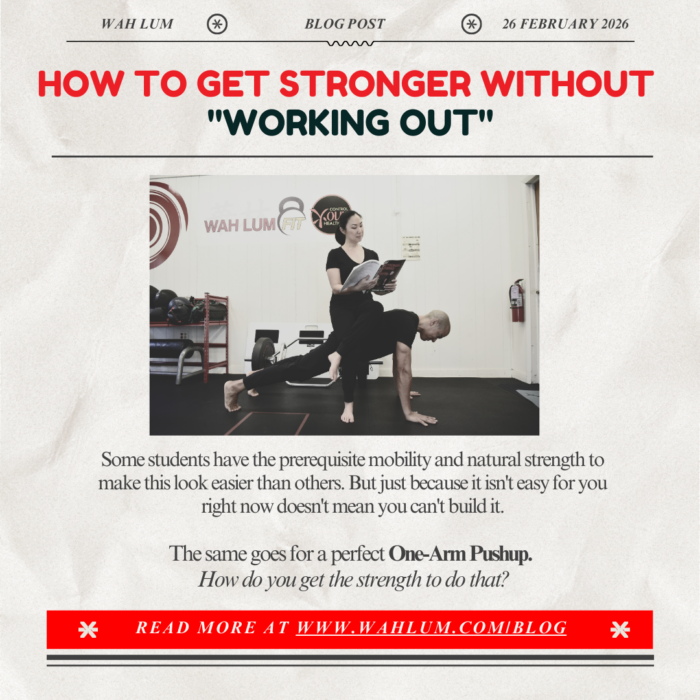
How to get stronger without “working out”

Have you ever looked at a high-level student perform a deep Tam Tui (one-legged squat) and wondered, “How do they have the strength to do that?”

The answer usually isn’t that they spend hours in the gym destroying their muscles.

Yes, some students have the prerequisite mobility and natural strength to make this look easier than others. But just because it isn’t easy for you right now doesn’t mean you can’t build it.

The same goes for a perfect One-Arm Pushup. How do you get the strength to do that?

The answer is to treat strength as a skill, not just a physical attribute.

There is a concept in strength training called “Greasing the Groove” (GTG). It was popularized by Pavel Tsatsouline in his book The Naked Warrior, and it is the perfect methodology for martial artists.

Here is how it works and how you can use it to master your bodyweight mechanics.

The Concept: Strength is a Skill

Imagine you are trying to learn a new song on the piano. Would you practice it once a week for 5 hours until your fingers bled and you were exhausted?

I guess that is an option. But the better option would be to practice it for 10 minutes a day, every day. You would play it perfectly, stop before you got tired, and come back to it later.

Greasing the Groove is the same concept applied to strength.

When you do an exercise, your brain sends a signal through your nervous system to your muscles. The more often you send that signal without fatigue, the more efficient the “groove” becomes.

The Rules of GTG

  1. Frequency over Intensity: You do the movement throughout the day, but never to failure.
  2. Stay Fresh: You should feel stronger after the set than when you started. If your max is 5 reps, you only do 1 or 2.
  3. Perfect Form: Because you are “grooving” a neurological path, every rep must be perfect. If you practice sloppy reps, you are greasing a sloppy groove.

The “Naked Warrior” Combo for Kung Fu

If you want to build full-body tension and power for your forms, try applying GTG to these two movements:

  1. The Tam Tui (One-Legged Squat/Pistol) In the fitness world, this is called a “Pistol.” In Wah Lum, it’s the strength behind our Tam Tui kicks and deep stances.
  • The Progression: If you can’t do a full one yet, don’t force it. Use a box to sit down on, or hold a doorframe for assistance.
  • The Groove: Every time you walk through a specific doorway in your house, do one perfect rep on each leg.
  1. The One-Arm Pushup This teaches total body integration, connecting the hand to the core to the feet.
  • The Progression: Start doing them on an incline (like against a kitchen counter or a staircase). As you get stronger, move lower to the floor.
  • The Groove: Every time you go into the kitchen, do one perfect rep on each arm.

The Result

By the end of the day, you might have done 10-20 reps of each exercise. By the end of the week, that can be up to 140 reps.

You aren’t sweaty. You aren’t sore. But your nervous system is learning how to fire those muscles with incredible efficiency.

So, pick a move you want to master. Stop trying to “workout” until you drop. Start greasing the groove.

As my strength coach Brett Jones would remind me about GTG, the reps are done fresh, frequently, and flawlessly. You need all three for each rep.

See you in training,

Sifu Oscar


P.S.  There are 2 ways I can help you Start the groove. 

  1. See it for yourself: The best way to understand Wah Lum is to see it in person. Email us kungfu@wahlum.com with Observation and we will set up a time for you to come visit a class.
  2. Guidance: The best way to get strong is to start small and be consistent. If you are looking for a program to help you build the habit of daily movement, Control System: Foundations is the blueprint. Email us kungfu@wahlum.com with FOUNDATIONS and I’ll send you the details.
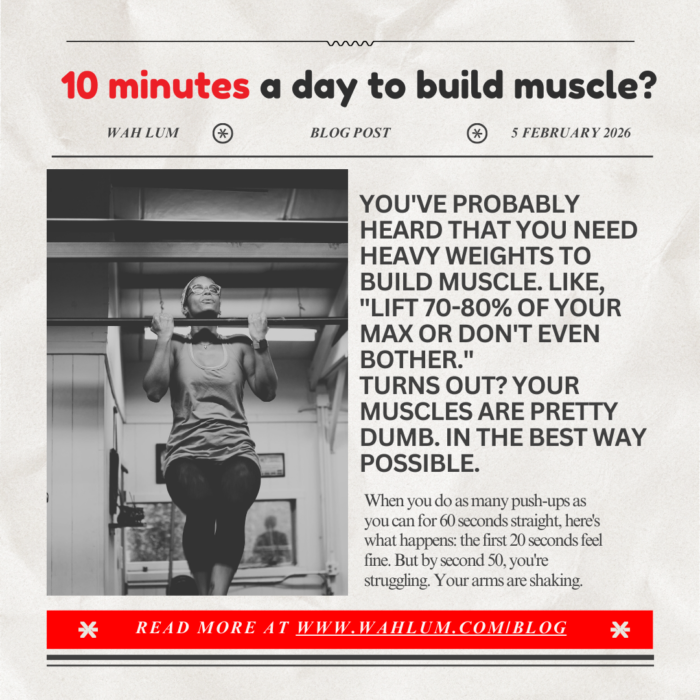
10 minutes a day to build muscle? (Actually, yes.)

Last week I told you that “10-minute Tai Chi walks” won’t build muscle. I stand by that.

But that doesn’t mean you can’t build muscle in 10 minutes. You just have to change the intensity.

I recently came across a study shared by Dr. Andy Galpin (worth following if you’re into this stuff) that completely changes the conversation for anyone who claims they are “too busy” to train.

Quick disclaimer: 10 minutes of air squats isn’t the same as actual training. We’re not delusional here.

But it turns out 10 minutes a day can build real, measurable muscle. Not magic, just science.

The Study: “Exercise Snacking” 

Researchers at the University of the Bundeswehr Munich wanted to solve a problem: despite resistance training being critical for health, most people don’t do it.

They took 30 women with sedentary desk jobs, the kind of jobs where you sit so long you forget you have legs, and split them into two groups.

  • Group A: Lived their normal lives.
  • Group B: Did “Exercise Snacks,” brief 10-minute bodyweight workouts during work hours, 5 days a week.

(You can read the full study here: Resistance exercise snacks improve muscle mass in female university employees)

The Results (The “Muscle Miracle”) 

After 12 weeks, the results were undeniable:

  • The Snacking Group: Gained 0.42 kg (about 1 lb) of lean muscle.
  • The Control Group: Lost muscle (which is typical as we age).

Now I know what you’re thinking. “Less than a pound? That’s it?”

But here’s where it gets interesting. Women typically lose about 1.1 kg of muscle per decade. These women reversed nearly half a decade of muscle loss in just three months, all while wearing their work clothes.

Why It Works 

You’ve probably heard that you need heavy weights to build muscle. Like, “lift 70-80% of your max or don’t even bother.”

Turns out? Your muscles are pretty dumb. In the best way possible.

When you do as many push-ups as you can for 60 seconds straight, here’s what happens: the first 20 seconds feel fine. But by second 50, you’re struggling. Your arms are shaking.

What is happening is your easy-to-recruit muscle fibers are tapping out. They’re done. So your body has to call in reinforcements, the bigger, harder-to-activate fibers that usually only show up when things get heavy.

By the end of that set, you’re recruiting nearly as many muscle fibers as you would with a loaded barbell. Your muscles don’t actually know the difference between “this weight is heavy” and “this effort is hard.” They just know they’re being challenged.

The Protocol: How to use this 

If you are already lifting heavy in the gym, keep doing that. But if you have been “meaning to start” for six months, or you spend most days sitting… this is your golden ticket.

Your 10-Minute Protocol: Set a timer for 10 minutes. Perform each exercise for 45-60 seconds (AMRAP: As Many Reps As Possible), then move to the next.

The “No-Gym” Menu (Pick the option that fits your joints):

  1. The Squat Slot: Standard Squats OR Wall Sits (if knees are sensitive)
  2. The Push Slot: Push-ups OR Wall Push-ups (stand further back to make it harder)
  3. The Single-Leg Slot: Reverse Lunges OR Standing Side Leg Raises (Great for balance, zero knee impact)
  4. The Core Slot: Plank OR Standing Knee Raises
  5. The Posterior Chain: Glute Bridges OR Standing Calf Raises
  6. The Finisher: Repeat your favorite one from above until the timer beeps!

The Secret Sauce 

You must do AMRAP (As Many Reps As Possible). Don’t just go through the motions like you’re checking a box. Make it hard. Feel the burn. Give yourself something to actually adapt to.

The Bottom Line 

This study matters because it removes the excuses. 

  • Can’t afford a gym? Don’t need one.
  • Don’t have time? It’s literally 10 minutes.
  • Don’t know how to use equipment? Bodyweight only.

Every single person in the study who finished it said they’d keep doing it afterward. That is unheard of in fitness research.

You don’t need to lie about Tai Chi to sell health.

If you want to lubricate your joints, regulate your nervous system, and build the kind of deep stability that prevents falls? Do Tai Chi.

And let’s face it: it is cool that you are practicing a traditional martial art. There is so much more you get from it than just physical health, like the martial intention, the mental focus, and the journey toward becoming the best version of yourself.

If you have 10 minutes and want to reverse muscle aging? Do Exercise Snacks.

-Sifu Oscar


Want to try the Exercise Snacks? Comment to this blog and let’s talk about how to make this work for your schedule. If you tell me your biggest “trouble spot” (knees, shoulders, or just lack of time), I can help you pick the right 6 moves from the menu above.

Curious about the Tai Chi side? If you want to see what “The Evidence in the Temple” looks like in real life—and see the balance and focus we talked about—come visit us.

You can view our Class Schedule Here. 

Better yet? Come see it in action. Comment with the word “OBSERVE” if you’d like to stop by and watch a class this week.

The Power Of One-Leg Squats In Kung Fu and Tai Chi

Today, I wanted to dive deeper into the power and benefits of one-leg squats for our students.

Our Kung Fu Students Know One-Leg Squats!

Our Style has Tam Tui in the name after all!

Performance science leader and coach Dr. Alex Natera has done an excellent job testing and categorizing the relative loading between the target and assisting the leg in various lower-body exercises. His research, using force plate data shows the following weight distribution:

– Bilateral Squat (your two-leg squat, or think of our Riding Horse Stance): 50/50

– Step-Up: 56/44

– Split Squat (think Kneeling Horse Stance for our Kung Fu students): 65/35

– Rear Foot Elevated Split Squat: 78/22

– Single-Leg Squat (Tam Tui or Pistol Squat): 100/0

Natera’s research also demonstrates that a one-leg squat with 50% body weight (BW) in external load equals a 2x BW back squat. For example, if you weigh 200 lbs and can do a one-leg squat with 100 lbs in external load, it would equate to a 400-lb back squat. 

Pretty impressive, right? 

Building Up to One-Leg Squats

It’s essential to build significant strength in a split squat before attempting a one-leg squat. Aim to lift 50% of your BW in a split squat first. This builds the motor control needed for one-leg squats and sets you up for success. 

Why are One-Leg Squats Important? 

– Greater Coordination: One-leg squats demand much more coordination. Taking one leg off the ground engages side-to-side stabilizer muscles like the adductors (inner thigh) and hip rotators (glute medius). 

– Lower Orthopedic Cost: One-leg squats, along with the other exercises mentioned, have a lower orthopedic cost. They challenge students with lighter loads, reducing negative side effects of spinal compression. 

However, that lower orthopedic cost comes with a warning: you have to be able to perform a bodyweight split squat pain-free first! Even if you never manage a full one-leg squat, you can still reap many of the benefits of single leg training with split squats or step-ups.

Embrace the challenge, and I would love to hear your thoughts or questions!

Sifu Oscar


P.S. Whenever you’re ready, here are ways we can help you get started.

1. Schedule a time to observe a class.
Interested in Kung Fu or Tai Chi?  First step is to watch a class and see if we would be a good fit! Email: kungfu@wahlum.com for an appointment.

2. Become part of my exclusive Coaching Group with CYH Remote Coaching.  Get personalized coaching delivered right to your phone and catered to your specific goals. Email: kungfu@wahlum.com for info.